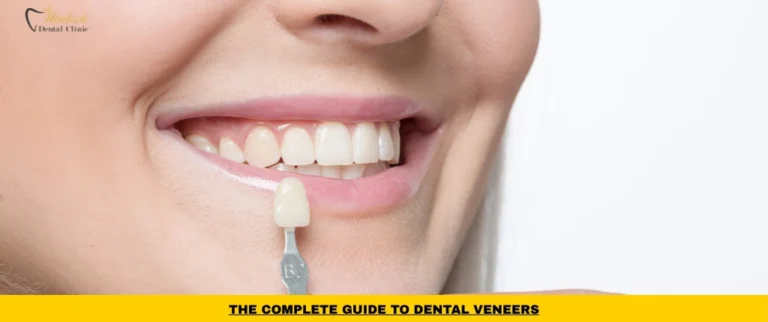
Veneers are thin, custom-made shells that cover only the front surface of your teeth. Unlike crowns, which wrap around the whole tooth, veneers are strictly cosmetic, not restorative.
Dental veneers are like press-on nails for your smile, but they are more durable. Your dentist shaves off a tiny bit of enamel (less than a millimeter), bonds the shell on, and puts it on the tooth. They won’t fix decay or weaken teeth, but for hiding imperfections, they’re magic. A crown, on the other hand, is for broken or root-canaled teeth that need full protection. In this article we will find out more details.
Types of Dental Veneers: Which One Is Right for You?
There are some types of veneers. Porcelain lasts longer and looks most real, composite is cheaper and done in one visit, no-prep keeps your enamel intact, and snap-ons are just for fun or temporary use.
Here’s a comparison:
| Type | Material | Lifespan | Visits | Reversible? | Best For |
|---|---|---|---|---|---|
| Porcelain | Ceramic | 10-20 yrs | 2-3 | No | Long-term, premium look, stain resistance |
| Composite | Resin | 5-7 yrs | 1 | Partly (some enamel removed) | Budget, quick fix, minor chips |
| No-prep / Lumineers | Ultra-thin porcelain | 10-20 yrs | 2 | Yes (if no enamel removed) | Minimal change, reversible option |
| Removable / Snap-on | Resin/plastic | 1-3 yrs | 1 | Yes | Costume, trial smile, very temporary |
| Palatal (lingual) | Gold/porcelain | 10+ yrs | 2 | No | Worn back surfaces (grinding, acid erosion) |
Porcelain vs Composite Veneers: Which Is Better?
Porcelain wins for durability and looks, but composite is less expansive and can be repaired easily. There’s no best one, it’s about what you prioritize:
| Factor | Porcelain | Composite |
|---|---|---|
| Durability | High (15-20 yrs) | Moderate (5-7 yrs) |
| Stain resistance | Excellent (coffee? red wine? no problem) | Moderate (will yellow over time) |
| Appearance | Most natural, translucent like real enamel | Good, but less depth and shine |
| Cost per tooth | 900-900-2,500 | 250-250-1,500 |
| Visits required | 2-3 (lab made) | 1 (directly on tooth) |
| Repair if damaged | Replace the whole veneer | Easily patched with more resin |
| Enamel removal | More (~0.5mm) | Minimal (~0.2-0.3mm) |
Veneers vs Crowns vs Bonding vs Whitening: How to Choose
Veneers mask multiple flaws on front teeth; crowns protect broken teeth; bonding fixes tiny spots; whitening only changes color. Choose based on what’s actually wrong:
| Treatment | Best For | Coverage | Tooth Prep | Lifespan |
|---|---|---|---|---|
| Veneers | Cosmetic flaws (chips, gaps, stains) | Front surface only | Mild (0.3-0.5mm) | 10-20 yrs |
| Crowns | Damaged, cracked, or weak teeth | Entire tooth | Significant (1.5-2mm) | 10-15 yrs |
| Bonding | Minor chips, small gaps, one dark spot | Specific area | Minimal (etching only) | 5-10 yrs |
| Whitening | Just discoloration (no other issues) | Surface only | None | 6 months-2 yrs |
If your teeth are healthy but ugly, veneers teeth. If they’re broken or decayed, crowns. If you have one little nick, bonding. Only yellow and nothing else? Whitening.
What Problems Can Veneers Fix?
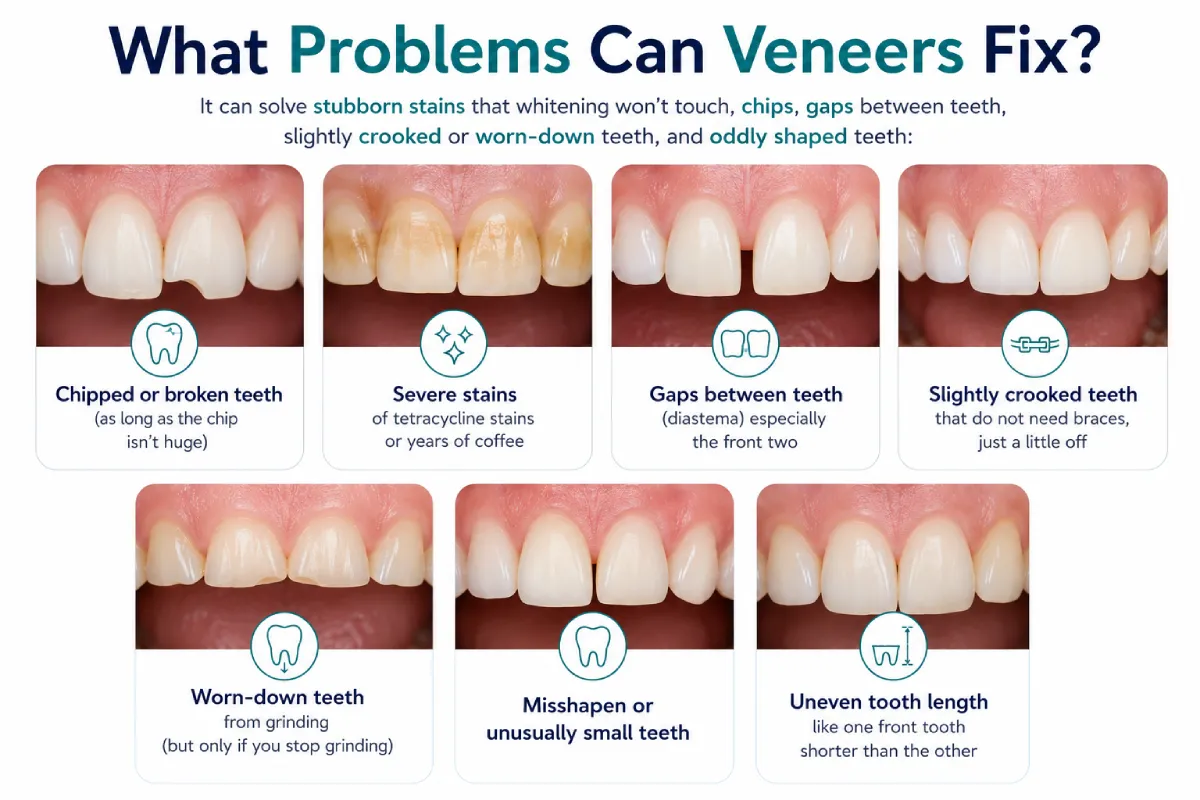
It can solve stubborn stains that whitening won’t touch, chips, gaps between teeth, slightly crooked or worn-down teeth, and oddly shaped teeth:
- Chipped or broken teeth (as long as the chip isn’t huge)
- Severe stains of tetracycline stains or years of coffee
- Gaps between teeth (diastema) especially the front two
- Slightly crooked teeth that do not need braces, just a little off
- Worn-down teeth from grinding (but only if you stop grinding)
- Misshapen or unusually small teeth
- Uneven tooth length like one front tooth shorter than the other
Are You a Good Candidate for Veneers?
You need healthy gums, enough enamel, minor cosmetic issues, and no heavy grinding. If you have cavities, gum disease, or very crooked teeth, fix those first.
| Good Candidate | Not Recommended (yet) |
|---|---|
| Healthy teeth and gums | Active gum disease or cavities |
| Enough natural enamel | Severe enamel erosion (teeth look translucent) |
| Minor cosmetic concerns | Severe misalignment (needs ortho first) |
| Realistic expectations | Heavy teeth grinding (bruxism) – unless you get a nightguard |
| Good oral hygiene | Untreated decay anywhere in your mouth |
| Fully developed adult teeth | Under 18 years old |
How Much Do Dental Veneers Cost?
If you ask how much veneers cost, here are the details:
Porcelain veneers run $900–$2,500 per tooth.
Composite veneers cost $250–$1,500 per tooth.
A full upper set of 8–10 teeth can cost $7,200–$25,000.
Insurance almost never covers veneers because they’re considered cosmetic.
Here’s what you’ll actually pay, including veneers pricing in Vancouver, depending on where you live and which dentist you choose.
| Type | Per Tooth | Full Set (8-10 teeth) |
|---|---|---|
| Porcelain | 900-900-2,500 | 7,200-7,200-25,000 |
| Composite | 250-250-1,500 | 2,000-2,000-15,000 |
| No-prep / Lumineers | 800-800-2,000 | 6,400-6,400-20,000 |
| Removable (full arch) | N/A | 500-500-2,500 |
For official numbers, the American Dental Association cost guide has more detail.
How Long Do Veneers Last?
Porcelain and Lumineers go 10-20 years (sometimes 25 with perfect care). Composite gives you 5-7 years, then you patch or replace.
Lifespan depends on you, not just the material. Here’s what to expect:
- Porcelain: 10-20 years (average 15)
- Composite: 5-7 years
- Lumineers: 10-20 years (same as porcelain)
What kills veneers early:
- Chewing ice, pens, and fingernails
- Grinding teeth at night (nightguard = mandatory)
- Using your teeth as tools (opening bags, ripping tags)
- Poor oral hygiene (gum disease loosens the bond)
The Veneer Procedure: What to Expect Step-by-Step
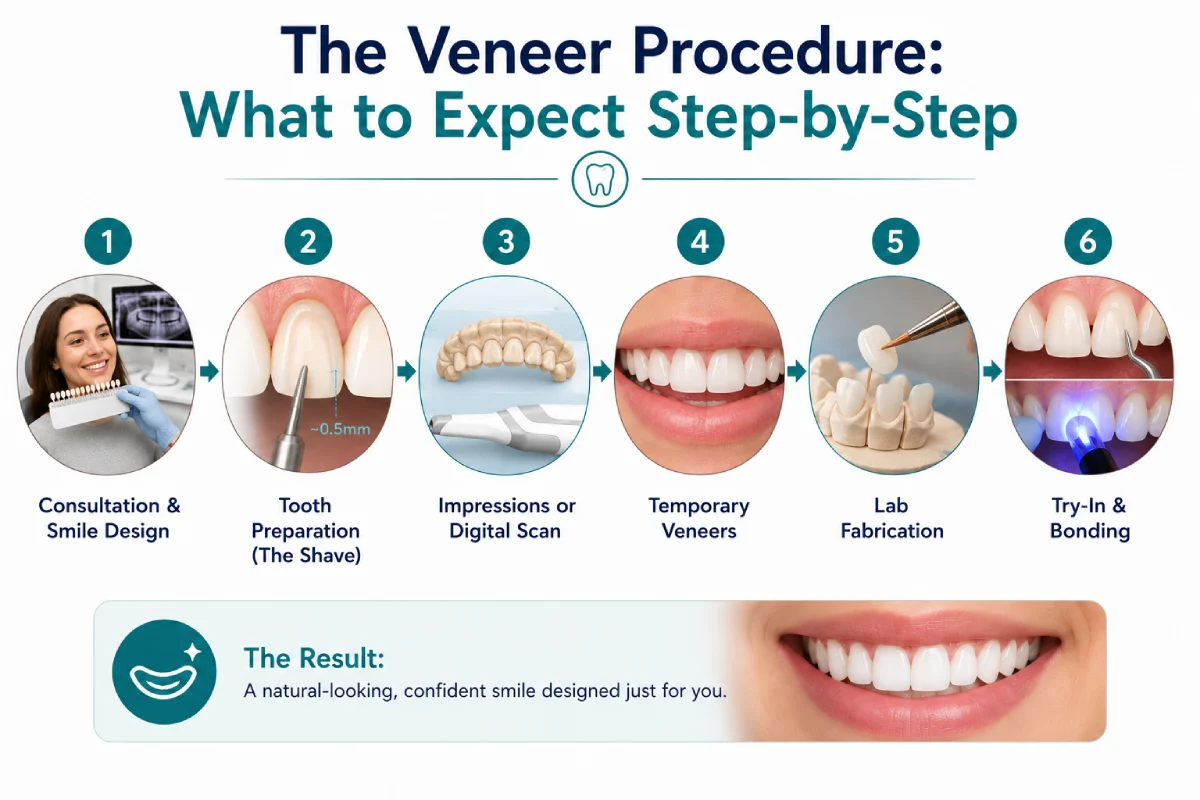
The process is straightforward but requires patience. Here is the exact journey from consultation to your new smile.
- Consultation & Smile Design: Your dentist discusses your goals, takes X-rays, and checks for gum disease or decay.
- Tooth Preparation (The Shave): The dentist removes a thin layer of enamel from the front of your teeth (about 0.5mm – less than a contact lens).
- Impressions or Digital Scan: A mold or 3D scan of your prepped teeth is sent to a dental lab.
- Temporary Veneers: For porcelain cases, you’ll wear temporaries for 2-4 weeks.
- Lab Fabrication: A master ceramist handcrafts your veneers to match your desired shape, size, and color.
- Try-In & Bonding: Your dentist will dry-fit each veneer to check fit and color. Then they etch your teeth, apply a strong bonding cement, and cure it with a special light.
- Bite Adjustment & Follow-up: They’ll check your bite to ensure no high spots. You’ll return in 2 weeks for a final check.
Are Veneers Painful?
No. Most patients report little to no discomfort.
During the procedure
You are completely numb with local anesthetic. You’ll feel pressure and vibration, but not pain.
After the procedure (first 1-2 weeks)
You may experience mild to moderate tooth sensitivity to hot or cold temperatures. This is normal as your teeth adjust to the new veneers. Over-the-counter pain relief, taken as directed by your dentist or pharmacist, usually settles it.
Recovery and What to Expect After Veneers
The adjustment period is short. Here is a realistic timeline:
- Days 1-2: Mild sensitivity to hot and cold. Stick to lukewarm, soft foods.
- Week 1: Your bite might feel “different” or bulky. This resolves as your brain adapts.
- Weeks 2-4: Full adaptation. You’ll forget you even have veneers.
- Aftercare tips during recovery: Avoid dark liquids (coffee, red wine, tea) for the first 48 hours so the bonding cement fully sets. Don’t bite into apples or corn on the cob for the first week.
How to Care for Your Veneers (Daily Routine)
Veneers don’t decay, but the tooth underneath can. Your care routine is non-negotiable.
- Brush twice daily with a non-abrasive toothpaste (avoid charcoal or whitening toothpastes, they scratch porcelain).
- Floss daily to remove plaque from the gum line where the veneer meets your real tooth.
- Avoid hard foods like ice, hard candy, popcorn kernels, and pens.
- Wear a nightguard if you grind your teeth.
- Limit staining drinks: coffee, red wine, tea, and cola (or use a straw).
- Use an alcohol-free mouthwash (alcohol can weaken the bonding cement over years).
- See your dentist for checkups and cleanings every 6 months.
- Never use your teeth as tools.
Pros and Cons of Dental Veneers
Here are pros and cons of dental veneers:
| Pros | Cons |
|---|---|
| Dramatically natural-looking results | Permanent enamel removal (irreversible) |
| Highly stain-resistant (porcelain) | High upfront cost (thousands of dollars) |
| Very long-lasting (10-20+ years) | Not covered by insurance (cosmetic) |
| Fast smile transformation (2-3 weeks) | Need eventual replacement (not forever) |
| Minimal enamel removal compared to crowns | Possible tooth sensitivity (usually temporary) |
| Fixes multiple issues (color, shape, gaps) at once | Not recommended for heavy grinders |
Risks and Things to Consider Before Getting Veneers
Consider these tips:
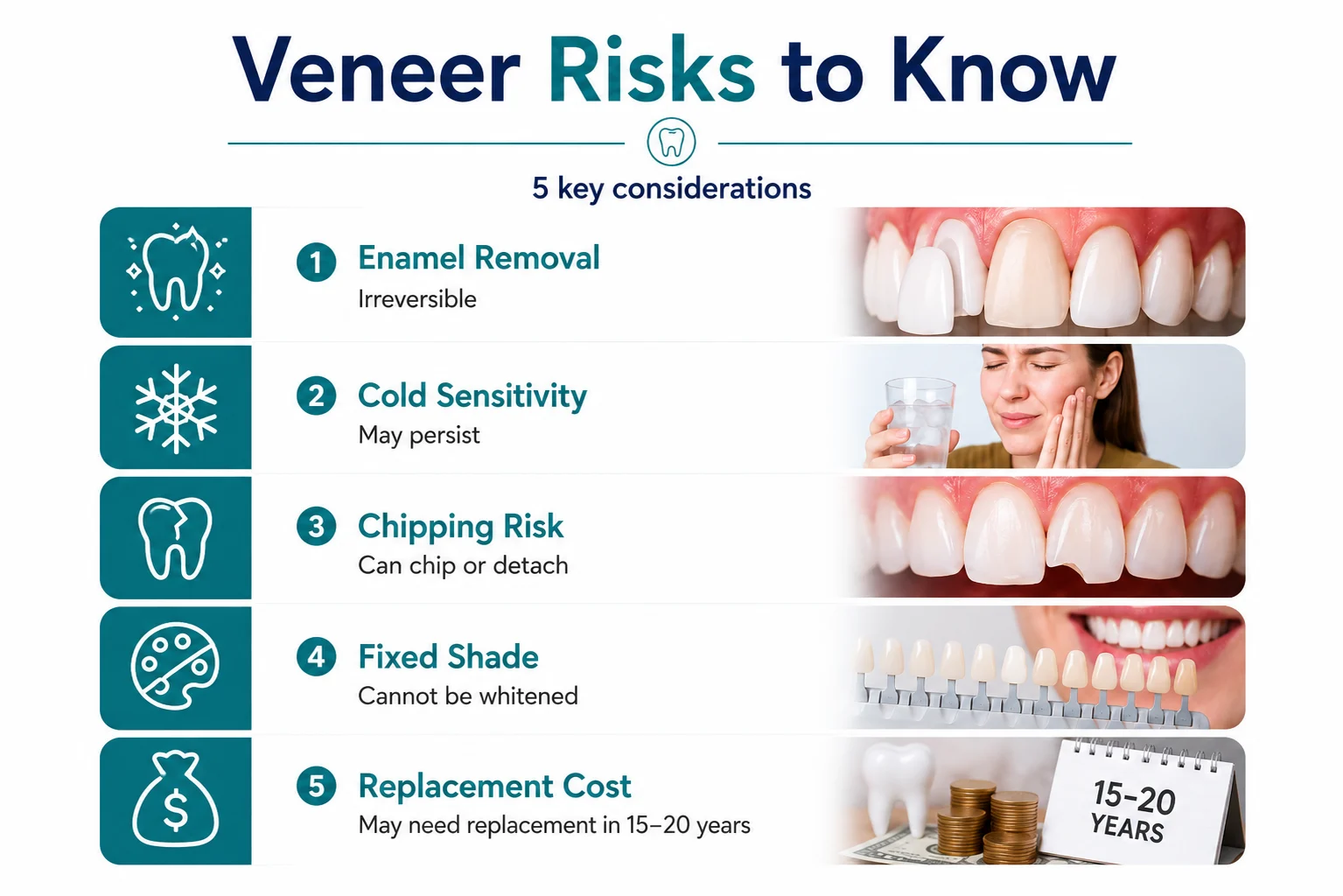
- Irreversible enamel removal: Once your natural enamel is shaved off, it never grows back. You will need to wear veneers or crowns for the rest of your life on those teeth.
- Possible permanent sensitivity: A small percentage of patients have lasting sensitivity to cold.
- Veneers can chip or detach: They are strong, but not unbreakable. A bad fall or biting a frozen candy bar can break one.
- Color cannot be changed: Once porcelain veneers are bonded, you cannot whiten them. Choose your shade carefully.
- Cost of eventual replacement: When they fail after 15-20 years, you pay full price again.
Are Cheap Veneers Abroad Worth It?
The honest answer is: they should be proceed with extreme caution:
- Quality control issues: Many labs use cheap, opaque porcelain that looks like Chiclets (fake, blocky, and white).
- No follow-up care: When one pops off after 6 months (common), you’re stuck paying a local dentist full price to fix a bad job.
- Communication barriers: Natural shape and color means something very different in different cultures.
- Different regulatory standards: You have zero legal recourse if they ruin your teeth.
- Hidden costs: Flights, hotels, missed work, and eventual repairs at home often make it more expensive than just doing it right locally.
If you are considering cosmetic dentistry Vancouver or any major city, pay for quality. Your teeth are not something to bargain.
Common Veneer Myths Debunked
Let’s clear up the misinformation.
- Myth: “Veneers ruin your teeth.”
Truth: A bad dentist ruins your teeth. A skilled cosmetic dentist preserves as much healthy enamel as possible.
- Myth: “Veneers look fake and bulky.”
Truth: Modern, high-quality porcelain veneers are virtually indistinguishable from natural teeth. Only cheap ones look fake.
- Myth: “Veneers fix all dental issues.”
Truth: They fix cosmetic issues. They do not fix cavities, gum disease, or bite alignment.
- Myth: “Anyone can get veneers.”
Truth: Many people need orthodontics or gum treatment first.
- Myth: “Once you get them, you can’t reverse it.”
Truth: For traditional porcelain veneers, this is true. The enamel is gone. That’s why candidacy is so important.
Real Patient Scenarios
These cases are based on real clinical experiences:
Case 1: Diastema (Gap) Closed with 4 Porcelain Veneers
A 34-year-old female hated the large gap between her two front teeth. She didn’t want braces. We placed 4 ultra-thin porcelain veneers on her upper incisors. Outcome: The gap was completely closed in 3 weeks.
Case 2: Tetracycline Staining Fixed with 8 Veneers
A 42-year-old male had gray, banded staining from childhood antibiotics (tetracycline). Whitening did nothing. We used high-opacity porcelain veneers on his top 8 teeth. Outcome: A bright, natural white smile for the first time in his life.
Case 3: When Veneers Weren’t Right
A 28-year-old wanted veneers for one slightly crooked tooth. But she had severe grinding (bruxism) and a deep bite. We refused veneers and referred her to an orthodontist for Invisalign and a nightguard. Outcome: She was annoyed initially, but two years later, she thanked us for saving her from cracked veneers.
What Cosmetic Dentists Consider Before Recommending Veneers
There’s a science to this. A general dentist choose veneers fast. An experienced cosmetic dentist first analyzes:
- Smile Design: The golden ratio, tooth proportions, and lip line.
- Bite Analysis: How your upper and lower teeth meet. A bad bite will fracture veneers.
- Tooth Health: Any decay or gum inflammation must be treated first.
- The Try-in Mockup: We always show you a 3D printed mockup or a composite mockup on your actual teeth before we drill anything.
If your dentist doesn’t do a mockup, find a different dentist.
Patient Reviews & Testimonials
Our patient, Tina Rezakhan, stated that:
“Everything is great, the clinic is very clean, all the staff are respectful, and the professional behavior of Dr. Alavi is unparalleled. I had a difficult surgery that she did in the best way. I recommend this place to all my loved ones who are looking for a great doctor and environment.”
Best Choices for Your Teeth at Hemlock Dental Clinic
Dental veneers, specifically porcelain, are the best cosmetic dental procedure for a complete smile transformation. They are durable, natural-looking, and life-changing for the right candidate. The key is to find an experienced cosmetic dentist, such as Hemlock Dental Clinic. Ready to see if you’re a candidate? Book a consultation with Dr.Alavi now.
FAQ
Do veneers ruin your real teeth?
No, if done correctly. A skilled dentist removes only a tiny amount of enamel (less than the thickness of a fingernail). However, the process is irreversible.
Can I get veneers on just one tooth?
Yes, but matching the color to your natural teeth is extremely difficult. Most patients get at least 2-4 veneers for symmetry.
Will my veneers look fake?
Only if you go to a cheap provider or choose an unnaturally bright white shade (like “Hollywood white”). Choose a natural shade.
How many veneers do I need?
Most people get 6-10 veneers on their upper teeth (the “social six” that show when you smile). The lower teeth are often left natural.
Can veneers be whitened?
No. Porcelain does not whiten. Choose your final color carefully before bonding.
What happens when veneers come off?
If one debonds, see your dentist immediately. The tooth underneath is exposed and sensitive. They can usually re-bond it.
Can I eat normally with veneers?
Yes, after the first week. But avoid biting into hard things like crab legs, bones, or ice.
Are veneers covered by insurance?
Almost never. They are cosmetic. Some plans may cover a small portion of composite bonding, but not porcelain.
Can I get veneers if I have crooked teeth?
For minor crowding or rotation, yes. For severe misalignment, you need braces or Invisalign first.
Do veneers stain like real teeth?
Porcelain veneers resist staining far better than natural enamel. Composite veneers do stain over time.
What’s the difference between veneers and Lumineers?
Lumineers are a brand-name version of “no-prep” veneers. They are thinner (0.2mm) and often require no enamel removal, but they can look bulky if your teeth are already prominent.
Can I drink coffee with veneers?
Yes. But for the first 48 hours after bonding, avoid it. Long-term, porcelain won’t stain, but the bonding cement at the edges might over many years. Rinse with water afterward.