This small dental appliance holds the space left by a missing baby tooth while the permanent tooth continues to develop. In some cases, a space maintainer can help.
But not every child who loses a baby tooth early needs one. The right choice depends on which tooth was lost, your child’s dental development, their bite, the space available, and several other factors. A dental exam can help determine whether a space maintainer for your child is actually needed.
What Is a Space Maintainer?
A space maintainer is a dental appliance used after a baby tooth is lost earlier than expected. Its job is to help keep nearby teeth from moving into the open space before the permanent tooth is ready to come in.
Space maintainers are commonly used in pediatric dentistry and can be fixed in place or removable.
The goal is to preserve the available space and support normal dental development. However, a space maintainer does not guarantee that a child will never need orthodontic treatment in the future.
Why Might a Child Need a Space Maintainer?
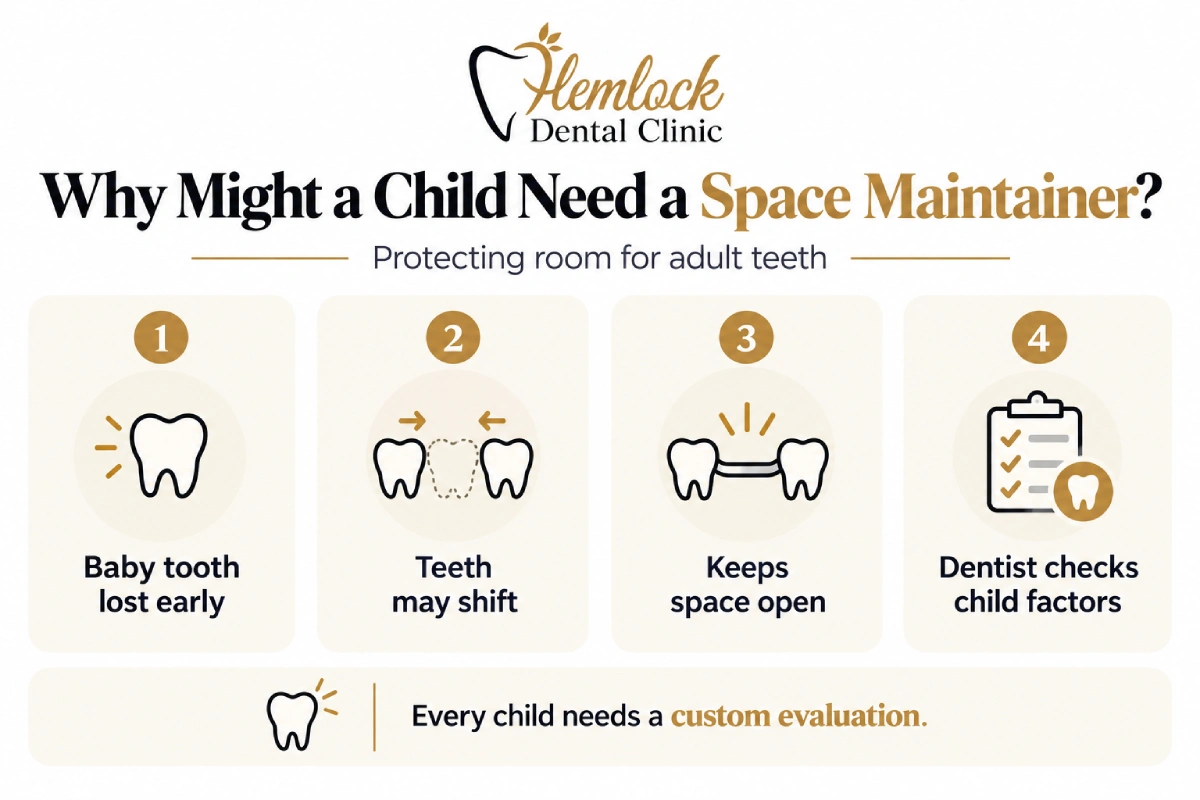
Baby teeth are temporary, but they still have an important job. In addition to helping children chew and speak, they help guide permanent teeth into the right area.
If a baby tooth is lost too soon, the teeth beside it may begin to move toward the empty space. This can reduce the room available for the permanent tooth underneath.
A dentist may consider a space maintainer after early tooth loss, but the decision is different for every child.
Factors that should be considered include:
- which baby tooth was lost
- how long ago the tooth was lost
- how much space is available
- your child’s bite
- your child’s dental age
- how far the permanent tooth has developed
- oral hygiene
- habits such as thumb or finger sucking
- your child’s overall health
- whether your child can comfortably cooperate with the appliance
These factors help the dentist decide whether holding the space is likely to be useful.
Does Every Child Who Loses a Baby Tooth Early Need a Space Maintainer?
No. Sometimes the permanent tooth is already close to coming in, or the location of the missing baby tooth does not require a space maintainer.
In other cases, leaving the space without treatment may allow nearby teeth to shift. This is why a dentist should look at the whole situation rather than recommending a child space maintainer simply because a baby tooth was lost early.
Types of Space Maintainers for Children
There is no single type of space maintainer that works for every child. The design depends on which tooth is missing, where it is located, the child’s dental development, and how well they can care for the appliance.
Fixed Space Maintainers
A fixed space maintainer is attached to one or more teeth and cannot normally be removed by the child.
Common examples include:
- Band and loop
- Crown and loop
- Distal shoe
- Lower lingual holding arch
- Nance appliance
- Transpalatal arch
Parents do not need to choose between these appliances themselves. Your dentist will recommend a design based on the location of the missing tooth and your child’s individual needs.
Removable Space Maintainers
A removable space maintainer can be taken out of the mouth.
These appliances may be suitable in certain cases, but they depend more on the child wearing and caring for them as directed.
Whether a fixed or removable space maintainer is more appropriate depends on more than how long the appliance will be worn. The missing tooth, bite, oral hygiene, dental development, and the child’s ability to cooperate all matter.
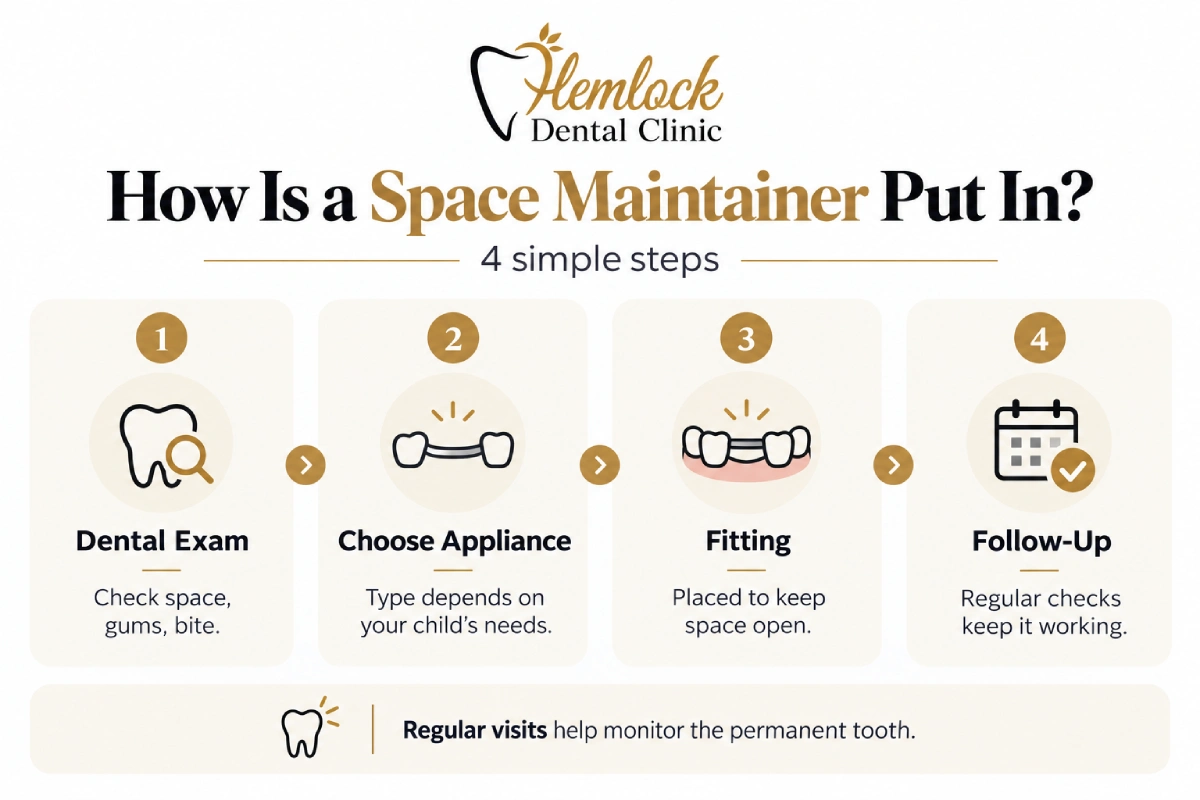
How Is a Space Maintainer Put In?
The process depends on the type of appliance and your child’s dental needs:
Step 1: Dental Exam
The dentist first checks the missing tooth area, nearby teeth, gums, bite, and available space.
Dental X-rays may be recommended when the dentist needs to see the developing permanent tooth or surrounding structures.
Step 2: Choosing the Right Appliance
If a space maintainer is recommended, the dentist chooses the type that best fits your child’s situation.
Some appliances are made for one side of the mouth, while others can help maintain space across a larger area.
Step 3: Fitting the Space Maintainer
The appliance is fitted so it can hold the needed space while allowing your child to eat, speak, and clean their teeth.
Depending on the type, more than one appointment may be needed.
Step 4: Follow-Up
A space maintainer should not simply be placed and forgotten.
Regular checks allow the dentist to make sure the appliance is still secure, clean, and working as intended. The dentist also watches the permanent tooth as it develops and begins to erupt.
How Long Does a Child Wear a Space Maintainer?
There is no set amount of time for every child. A space maintainer for a missing baby tooth may stay in place until the permanent tooth is ready to come into the correct area. The timing depends on your child’s age, the tooth involved, and how quickly the permanent tooth is developing.
As your child grows, the appliance may need to be adjusted, repaired, recemented, replaced, or removed. That is why regular follow-up visits are important.
How Much Does a Space Maintainer Cost in Vancouver?
There is no single price that applies to every space maintainer. The cost of a space maintainer in Vancouver can depend on:
- the type of appliance
- whether it is fixed or removable
- how many teeth or spaces are involved
- whether dental X-rays are needed
- how complex the case is
- whether the appliance later needs repair or replacement
- your dental insurance coverage
After examining your child, the dental team can explain which appliance is being recommended and provide a treatment estimate based on that specific plan.
If you have dental insurance, coverage can also be checked before treatment so you have a clearer idea of your expected cost.
Are There Any Risks or Problems With Space Maintainers?
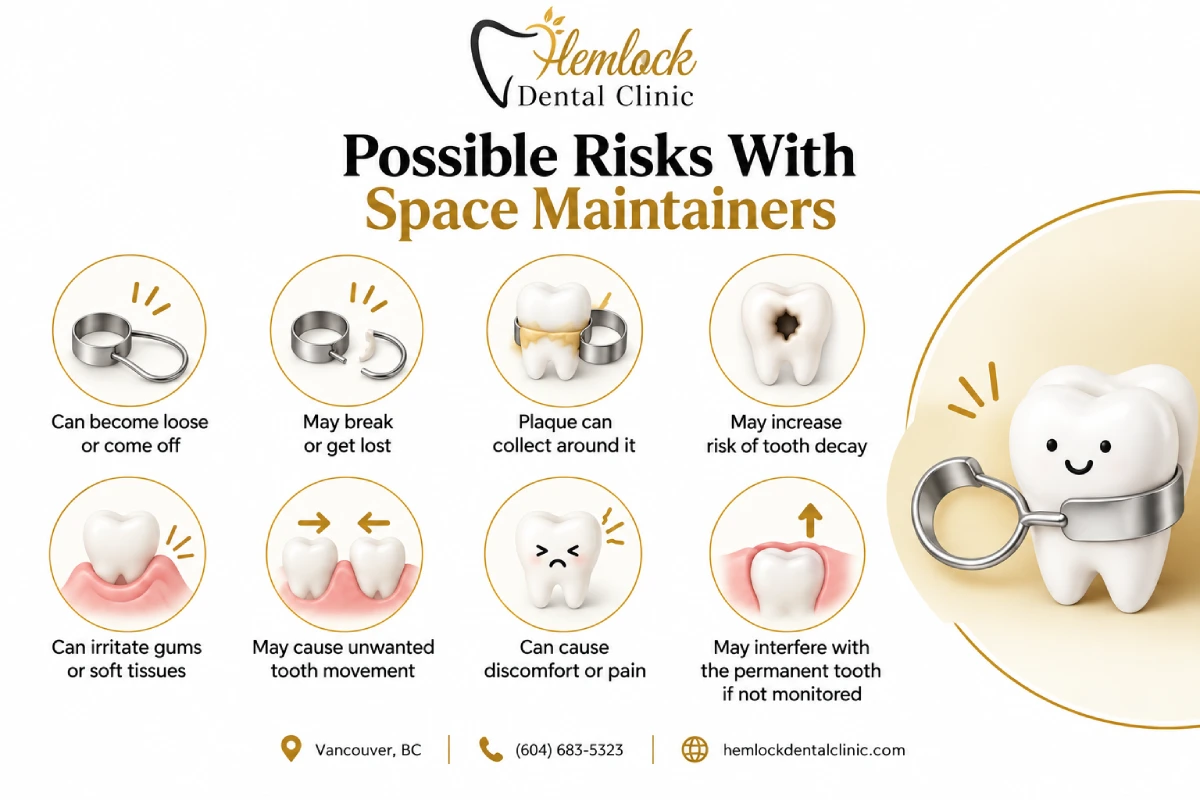
Space maintainers can be useful, but like other dental appliances, they can sometimes cause problems. Possible issues include:
- the appliance becoming loose or coming off
- breaking or getting lost
- plaque collecting around the appliance
- tooth decay if the area is difficult to clean
- irritation of the gums or other soft tissues
- unwanted tooth movement
- discomfort or pain
- interference with the permanent tooth if the appliance is not monitored properly
The AAPD therefore recommends regular assessment of the appliance and monitoring of the permanent tooth underneath.
If your child’s space maintainer becomes loose, breaks, starts hurting, or seems to be pressing into the gums, contact your dentist rather than trying to adjust it at home.
Can a Space Maintainer Prevent Future Braces?
Not necessarily. A space maintainer is designed to help preserve space after early loss of a baby tooth. It does not guarantee that your child will avoid crowding, bite problems, or orthodontic treatment later.
The AAPD notes that early loss of a primary tooth can lead to loss of available space, but the evidence about how much space maintainers prevent or reduce future malocclusion is not conclusive.
The goal is therefore to manage the space appropriately based on your child’s current dental development, not to promise that braces will never be needed.
How to Care for a Child’s Space Maintainer
Good daily care helps protect both the appliance and the teeth around it.
Because a fixed appliance makes the nearby teeth harder to brush, some children also benefit from fluoride treatments and sealants to lower the risk of cavities in that area.
Encourage your child to:
- brush carefully around the space maintainer
- keep the surrounding teeth and gums clean
- avoid playing with the appliance using their tongue or fingers
- follow any food instructions given by the dentist
- attend recommended dental checkups
Regular visits are especially important because children’s mouths are constantly changing as new teeth come in.
During these visits, the dentist can check whether the appliance is still secure and whether it needs adjustment, recementation, repair, replacement, or removal.
Why Choose Hemlock Dental Clinic for Your Child’s Space Maintainer?
Children can feel unsure about dental treatment, especially when they are trying something new. At Hemlock Dental Clinic, we are experienced in treating children’s teeth. The first step is to understand what your child actually needs. Before recommending a space maintainer, the dentist can examine the missing tooth area, your child’s bite, available space, and dental development. If an appliance is needed, the treatment and follow-up plan can be explained in simple terms, so both you and your child know what to expect. Contact us to set an appointment with Dr. Alavi.
FAQs
What happens if my child does not get a space maintainer?
After some baby teeth are lost early, nearby teeth may move into the open space and leave less room for the permanent tooth. But this does not happen in every situation. A dentist can check whether space loss is a concern before recommending treatment.
Are space maintainers painful for kids?
A properly fitted space maintainer should not normally cause ongoing pain. Your child may need some time to get used to having an appliance in their mouth.
Can my child eat normally with a space maintainer?
Most children can continue eating normally after they become comfortable with the appliance, although your dentist may recommend avoiding certain foods depending on the type of space maintainer.
Can a space maintainer affect the permanent tooth coming in?
A space maintainer is intended to preserve room while the permanent tooth develops. However, the permanent tooth and the appliance need to be monitored.
What should I do if my child’s space maintainer comes loose?
Do not try to bend, glue, or repair it yourself. Contact your dental clinic so the appliance can be checked.