Healing after wisdom teeth removal happens in stages. The inside of your gums and jawbone keeps repairing itself for several weeks, but most people start to feel much better within about 7–14 days. Your exact wisdom teeth recovery timeline depends on how many teeth were removed, whether they were impacted, if stitches were used, your age, whether you smoke, and how closely you follow your post‑operative instructions. In this day by day wisdom teeth recovery guide, you’ll see what is usually normal, what to expect at each stage, and which warning signs mean you should call your dentist. If you need quick help, fill out the form on this page or call us
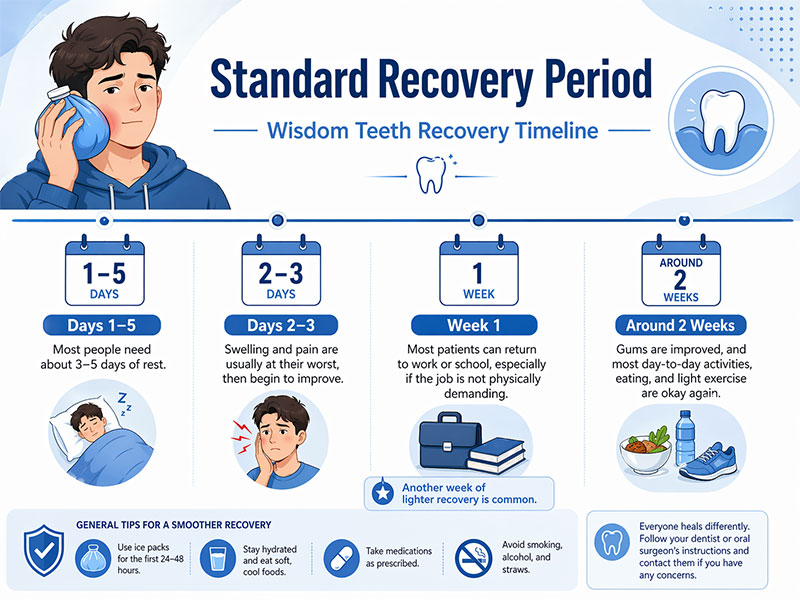
Quick Response: Standard Recovery Period
In wisdom teeth recovery timeline, general dentistry suggest that Most people need about 3–5 days of rest after wisdom teeth removal, followed by another 1–2 weeks of gradual recovery. According to general dental guidelines and sources like Cleveland Clinic, you can expect different healing speeds for different tissues:
- Feeling better (daily comfort):
Pain and swelling are usually worst around days 2–3, then begin to improve. Many patients feel well enough to return to work or school (if it’s not very physical) within about 5–7 days.
- Gum healing:
The gum tissue typically closes and becomes much more comfortable within 1–2 weeks, although the area can still feel a bit tender if you press on it or chew directly on the sites.
- Bone healing (deep healing):
The jawbone under the gums takes longer to fully heal. Early bone healing progresses over several weeks, and complete remodeling can take a few months, even though you usually feel normal much earlier.
Day by Day Wisdom Teeth Recovery Guide
All the patients are unique, and this is what most of the people go through after feeling impacted wisdom tooth symptoms or wisdom teeth surgery. Here is a day by day wisdom teeth recovery timeline:
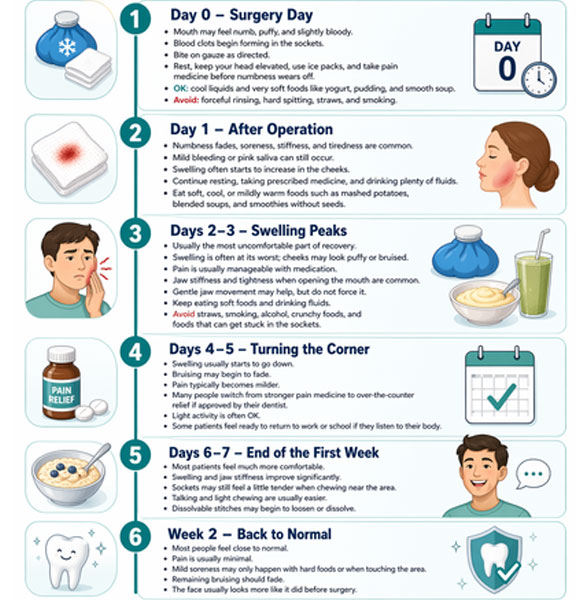
Day 0 – Surgery Day
Your mouth will be numb and puffy right after surgery. This might result in a little bit of bleeding, which is normal because the blood clot develops in each socket. The emergency dentist Vancouver or oral surgeon will put gauze in place and provide you with clear instructions on the length of time to bite down on the gauze. The primary objectives of day 0 are to rest, keep your head slightly elevated, apply ice packs as directed and take pain medicine before the numbness fades.
Rinsing your mouth too hard, spitting hard, drinking with a straw, or smoking during this day should be avoided as these activities can interfere with the blood clot and make you more likely to get a dry socket. It is all right to drink cool liquids and take very soft food such as yogurt, pudding or smooth soup.
Day 1- After Operation
By day 1, the numbness should have passed and you can be sore, stiff and tired. Many people even ask do wisdom teeth cause sore throats? Yes. Light to moderate bleeding or pink saliva may still occur particularly when you stand up, speak more, or replace the gauze. Swelling normally begins to swell around this period and can be more pronounced on your cheeks.
The task you still have to do on this day is to rest, take your pain medication as prescribed and drink a lot of fluids. You can also move on to soft, cool or mildly warm, foods that do not need any chewing, including smoothies without seeds, mashed potatoes or blended soups.
Days 2–3 – Swelling Peaks
The most uncomfortable days are normally days 2 and 3 because you will feel impacted wisdom tooth symptoms .The swelling is usually most extreme, and your cheeks can be very puffy or bruised. The pain may still be felt but to most individuals, it remains within control with medication.
This is normal during this period when you experience tightness when you want to open your mouth, and your jaw muscles become stiff and fatigued. Moving gradually (slowly opening and closing within your comfort zone) will be helpful in the long run, but do not push it. Continue to use soft foods and lots of fluids. Still, you must avoid the use of straws, smoking, alcohol, crunchy foods and things that would scratch or get stuck in the sockets.
Days 4-5 – Turning the Corner.
In days 4 and 5 many individuals realize that the swelling generally starts to retreat rather than increase, and bruising can begin to fade on the cheeks. The pain in this stage should be less and most patients can change their strong pain pills to over the counter drugs as long as their dentist would allow.
Most of the time light activities around the house are alright, and when you are at your desk job you might be feeling like going back to work or school provided you still pay attention to your body.
Day 6-7 – Day of the First Week
Most patients become a lot more comfortable by the end of the first week. The swelling is generally improving a lot and jaw stiffness is also improving. The sockets can be a little tender when you press on the area or chew too near it, but with talking and light chewing, the sockets are generally not as problematic.
You might find some of your dentist-placed dissolvable stitches beginning to loosen or melt at about this time. Need more details about wisdom teeth recovery timeline? Contact us now at Hemlock Dental Clinic.
Week 2 – Back to Normal
In the second week, the majority of the individuals believe that they are nearly normal. The pain is not very severe and the soreness most of the time can be noticed only when you chew something that is too hard or when you touch the area itself. Any bruising left on your cheeks ought to go away and your face will resemble more like it was prior to the surgery.
You can read more on Cleveland Clinic (Wisdom teeth removal / impacted wisdom teeth).
Can Wisdom Teeth Cause a Sore Throat?
Yes, wisdom teeth can sometimes cause a sore throat. This usually happens when a partially erupted or impacted wisdom tooth irritates the surrounding gum tissue and leads to inflammation or infection. Because the wisdom teeth are located close to the back of the throat, this irritation can cause discomfort that feels like a sore throat, especially when swallowing or opening your mouth.
What is Normal and Warning Signs?
Normal things in the initial few days are mild to moderate pain that gradually improves, swelling, which peaks at days 2-3 and then begins to reduce, slight bruising on the cheeks which is yellow or green, slight jaw stiffness, slightly bad taste or smell on the healing sockets. Minimal pink saliva upon brushing or rinsing are also rather normal at the beginning.
Symptoms of wisdom tooth infection which show the need to call your dentist immediately are:
- When the pain starts to get worse,
- If the pain becomes severe and spreads to your ear or jaw,
- When the odor or flavor in your mouth is very foul,
- If you have a fever or chills,
- In the case the swelling on your face suddenly becomes worse,
- When you have difficulty breathing or swallowing, or when you find yourself bleeding heavily and it does not lessen.
Dry Socket: When Pain Suddenly Gets Worse
Dry socket occurs when the blood clot in the extraction site dissolves or becomes dislodged exposing the bone and nerves. It typically occurs several days after surgery, typically within the range of days 3-5 and it is very intense, deep pain that may extend to your ear or down to your jaw.
When you see a dry socket in the mirror, it may appear empty or whitish, rather than reddish darker, and you might find a bad odor in that region. Aggressive smoking, spitting, or rinsing during the first days can increase your risks. In case you suspect that you have a dry socket, contact us.
Eating, Drinking & Brushing Timeline (Day-by-Day Mini Guide)
Here is a day by day wisdom teeth recovery timeline:
During the initial 24 hours, be careful about cool fluids and soft and smooth food such as yogurt, applesauce, and blended soups. Hot, spicy, crunchy or chewy food, straws and alcohol should be avoided. You can continue to add soft foods like mashed potatoes, scrambled eggs and smoothies without seeds after the first day.
Between days 4-7, you can eat a bit more solid food, like soft pasta, tender fish and soft fruits, chew on the opposite side of the surgery. You can brush your teeth twice a day, but it must be soft around the surgery and as advised by your dentist salt water rinses. In week 2 you are allowed to progress back to your normal diet, but continue to avoid very crunchy foods until your dentist advises otherwise.
How Long Should You Take Off Work / Gym?
The time you will need off will rely on the kind of work you perform as well as the number of tooth extractions. Light walking is commonly sufficient as exercise during the first few days as long as you feel stable and your pain is under control. Intense exercise, running and heavy lifting of weight is normally advisable only after approximately a week or as advised by your dentist.
Wisdom Teeth Recovery at Hemlock Dental Clinic
Fast Wisdom Teeth Recovery at Hemlock Dental Clinic
Fast, comfortable wisdom teeth recovery starts at Hemlock Dental Clinic. Our gentle dental team, and Dr.Alavi use advanced techniques to reduce pain, speed healing, and help you get back to your routine sooner. Need relief or ready to plan ahead? Book your appointment with Hemlock Dental Clinic today.
FAQ
What Is the Worst Day of Wisdom Teeth Recovery?
Days 2 and 3 are usually the hardest after wisdom teeth removal because swelling and jaw stiffness are often at their worst. Most people start feeling better after these days. If pain suddenly gets worse between days 3 and 5, contact your dentist because it could be a sign of dry socket
How long does wisdom teeth recovery really take?
Most individuals experience recovery of most of the illness within 1-2 weeks with the agony being the worst on the initial days. But it takes several weeks before the bone and deeper tissues are completely healed.
When will I get back to eat normal food?
Eat soft foods on initial few days, after which you will gradually include additional solid foods as the chewing process will become easier. By the end of the second week, many patients are ready to resume most of their usual die.
Does jaw feel stiff?
Yes, it is very normal that the jaw is stiff after having wisdom teeth removed, in the first week. Usually it gets better over time as the swelling dies, slow opening and closing in your comfort zone may be beneficial but do not make your mouth open.
Do wisdom teeth cause sore throats?
Yes, partially inflamed or even erupted wisdom teeth may sometimes lead to sore throat, particularly when the neighboring gum is inflamed or infected.
Can wisdom tooth cause cold like symptoms?
Yes, if you have an erupted wisdom tooth, it can cause cold-like symptoms.
When do I need to call my dentist?
You need to contact your dentist in case your pain suddenly intensifies after a few days, you have a bad smell that is strong, you have fever, chills, swelling continues to increase, or when you experience difficulty in breathing or swallowing.