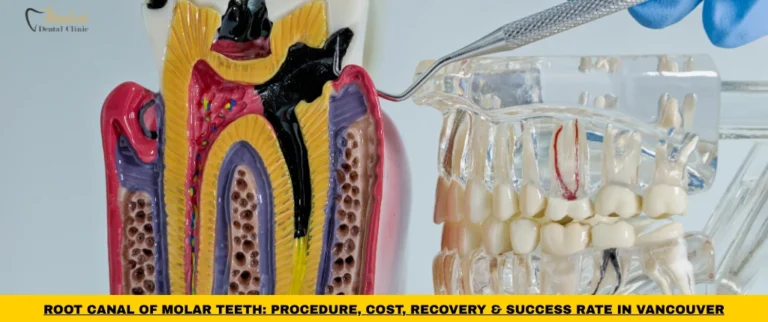
A molar root canal in Vancouver usually takes longer than treatment on a front tooth because molars have more roots and canals to clean. Treatment often takes around 90 to 120 minutes and may be completed in one or more appointments, depending on the tooth and the complexity of the case.
At Hemlock Dental Clinic, the listed molar root canal cost is about $1,200 to $1,800 before a crown. If a crown is needed afterward, the total treatment cost may be higher.
Most people can return to their normal routine soon after treatment. Mild tenderness for a few days is common, and you should avoid chewing on the treated tooth until your dentist says it is safe.
Why Are Molars More Complex for Root Canal Treatment?
The root canal on a molar tooth is different from the root canal treatment of front teeth. They are located at the back of the mouth and are more complex than those in the front, and more time and specialized skills are needed to treat them correctly. The complexity depend on:
- Multiple roots and 2-3 roots per molar tooth.
- Multiple canals, 3 – 4 (or more) in upper molars
- Narrow or curved canals which are hard to clean thoroughly
- Hard-to-reach location at the back of your mouth
A higher chewing pressure is needed, which necessitates more robust restoration materials.
Molar Anatomy: How Many Roots and Canals Does a Molar Have?
Understanding molar anatomy helps explain why the process of molar root canal Vancouver are more involved. The number of roots and canals varies according to which root canal of molar teeth:
| Tooth | Roots | Canals |
|---|---|---|
| Upper first molar | 3 | 3-4 |
| Upper second molar | 3 | 3-4 |
| Upper third molar (wisdom) | 1-3 | Variable |
| Lower first molar | 2 | 3-4 |
| Lower second molar | 2 | 3 |
| Lower third molar (wisdom) | 1-2 | Variable |
Upper Molar vs Lower Molar Root Canal: What’s the Difference?
Upper and lower molars have distinct anatomical differences that affect the treatment approach. Your dentist considers these variations of root canal procedure molar when planning your procedure:
| Factor | Upper Molar | Lower Molar |
|---|---|---|
| Roots | 3 typically | 2 typically |
| Canals | 3-4 (sometimes 4 in MB root) | 3 (rarely 4) |
| Common challenge | Hidden MB2 canal | Curved mesial roots |
| Sinus involvement | Possible | No |
| Procedure time | Slightly longer | Slightly shorter |
How Long Does a Root Canal on a Molar Take?
A molar root canal typically requires 90 to 120 minutes compared to 30 to 60 minutes for front teeth. The additional time ensures all canals are properly located, cleaned, shaped, and sealed.
- Single visit: 90 to 120 minutes total
- Two visits: 60 to 75 minutes per visit
- Reason: more canals to find, clean, shape, and fill with precision
How Many Visits Are Needed for a Molar Root Canal?
Most molar root canals require one to two visits depending on infection severity and anatomical complexity.
- One visit: simple cases with no infection spread
- Two visits: moderate infection or complex anatomy
- Three or more visits: severe infection or retreatment scenarios
- Crown placement: typically scheduled as a separate visit after healing
Is a Root Canal on a Molar Painful?
No, a molar root canal is not painful when performed, due to the use of effective local anaesthetic. The procedure is like having a normal filling:
During the Procedure
The mouth will be totally numb during the procedure. You might feel pressure, vibrations, but not pain, during the dentist’s work on your tooth.
After the Procedure
Soreness for 2-4 days is a normal part of the procedure and it is slightly more apparent with the molars. Acute pain can be treated with over-the-counter pain medication.
What Happens During a Molar Root Canal
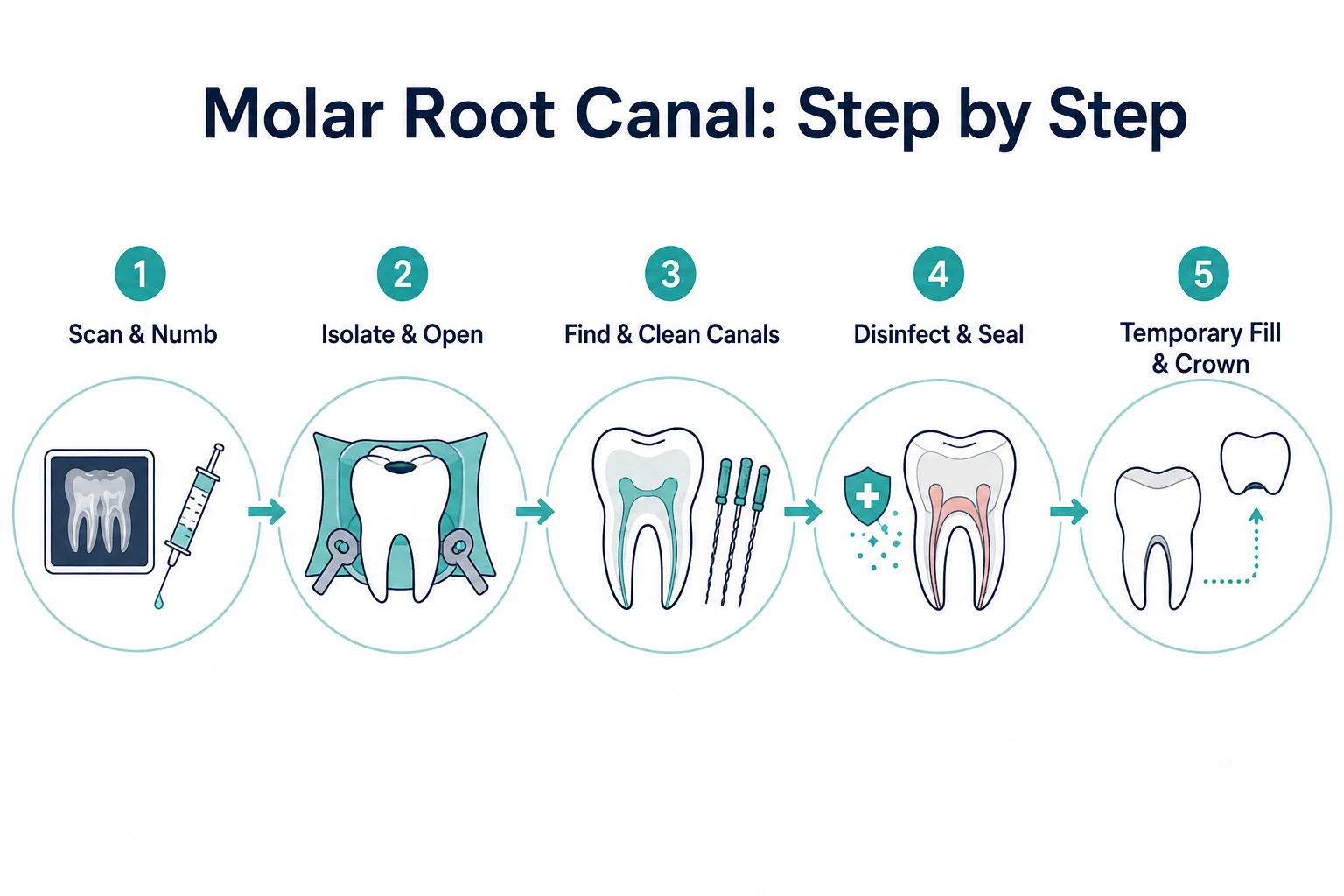
Typically, the molar root canal treatment takes a few straightforward steps:
- Your dentist checks the tooth and gets X-rays. Further imaging (CBCT) may be recommended in more complex cases.
- The tooth is numbed, and then made comfortable with local anesthetic during treatment.
- A rubber dam is used around the tooth to provide a clean and dry treatment area.
- A small opening is created to get into the canals.
- The infected or broken tissue is cut off and cleaned, and every canal is well cleaned and trimmed.
- The cleaned canals are also filled and sealed to minimize the risk of re-infection of bacteria.
- The tooth is restored (temporary or permanent). Many molars require a crown following that is to help protect them.
Do You Need a Crown After a Molar Root Canal?
A crown may be necessary on molars following root canal therapy because molars receive a lot of chewing pressure.
A crown can help maintain the integrity of the remaining tooth structure and prevent fracture.
The final restoration will depend upon the amount of healthy tooth remaining and the condition of the tooth. Your dentist will determine which crown or other restoration will work best for you.
For more information about saving your natural tooth, visit the American Association of Endodontists.
How Much Does a Root Canal on a Molar Cost?
The cost of molar root canal treatment is higher than the anterior teeth due to the complexity and time required for the treatment.
- Molar root canal: $1,200 to $1,800 without crown
- Crown for molar: $1,000 to $1,500
- Total treatment cost: $2,200 to $3,300
This will be about 20-30% more expensive than anterior root canal treatment.
The actual cost will vary according to the tooth, the number and shape of the canals, the complexity of treatment, and the type of final restoration desired. Your dentist will provide a better estimate once she examines the tooth and looks at your X-rays.
Does Dental Insurance Cover a Molar Root Canal?
Yes, some dental plans will offer coverage for root canal treatment, depending on the plan. What you can expect to owe out of pocket will depend on your deductible, coverage percentage, annual maximum and coverage for a crown.
Root canal treatment is one of the endodontic treatment options covered under the Canadian Dental Care Plan (CDCP) as per their rules and eligibility. Before the treatment, it is good to review your benefits or to ask the dental office to explain your coverage.
Molar Root Canal Success Rate
When root canal treatment Vancouver is done correctly and with a crown, modern molar root canal therapy can have very good long-term results.
- With modern methods: the overall success rate is 85 to 95 percent.
- With proper crown placement: significantly improved longevity
- No crown restoration: significantly increased risk of fracture of the tooth needing extraction
Complete canal cleaning, sealing and good quality crown restoration are the key success factors.
Molar Root Canal Recovery: What to Expect
The recovery from a molar root canal will be relatively easy. Some soreness may be felt for several days, but will improve over time.
The First Few Hours
Your mouth will be numb for approximately 2-4 hours. Don’t eat anything until the numbness has passed to prevent licking the cheek, tongue, and/or lip.
Day 1
There is slight tenderness in the tooth and surrounding area, particularly when chewing or biting. This is typically for a short period.
Days 2–3
There may be some mild soreness and this should improve. If the tooth has a temporary filling, try chewing food on the other side of your mouth.
Days 4–7
By this time, most of the tenderness has eased for many. Brush and floss as usual but take care when flossing around the treated tooth.
After the Root Canal
Avoid hard or very sticky foods on that side until the tooth has been restored. Your dentist will advise you at what time you can chew normally again.
What If The Root Canal In My Molar Fails?
Failure to treat is uncommon, but can happen if infections do not resolve or new issues arise. What should we do:
First choice for re-cleaning and re-sealing root canals.
If it is not possible to be treated again, a surgical procedure called apicoectomy may be performed.
Extraction plus implant: Last option if the tooth is not able to be saved
The endodontist has the ability to successfully manage most failures.
Molar Root Canal vs Extraction: Which Is Better?
Preserving your natural tooth through root canal treatment is generally the preferred option when possible. Compare these factors to see why do I need a root canal:
| Factor | Molar Root Canal | Extraction + Implant |
|---|---|---|
| Preserves natural tooth | Yes | No |
| Time to complete | 1 to 3 visits | 3 to 6 months |
| Total cost | $2,200 to $3,300 | $4,000 to $6,000 |
| Bone preservation | Yes | Initial bone loss occurs |
Common Mistakes to Avoid After a Molar Root Canal
Avoiding these mistakes ensures your treated tooth heals properly and lasts for many years.
- Skipping crown placement thinking the tooth feels fine
- Chewing hard foods on the treated tooth before crown installation
- Eating sticky or crunchy foods too early in recovery
- Missing follow-up X-ray appointments
- Ignoring pain that continues beyond one week
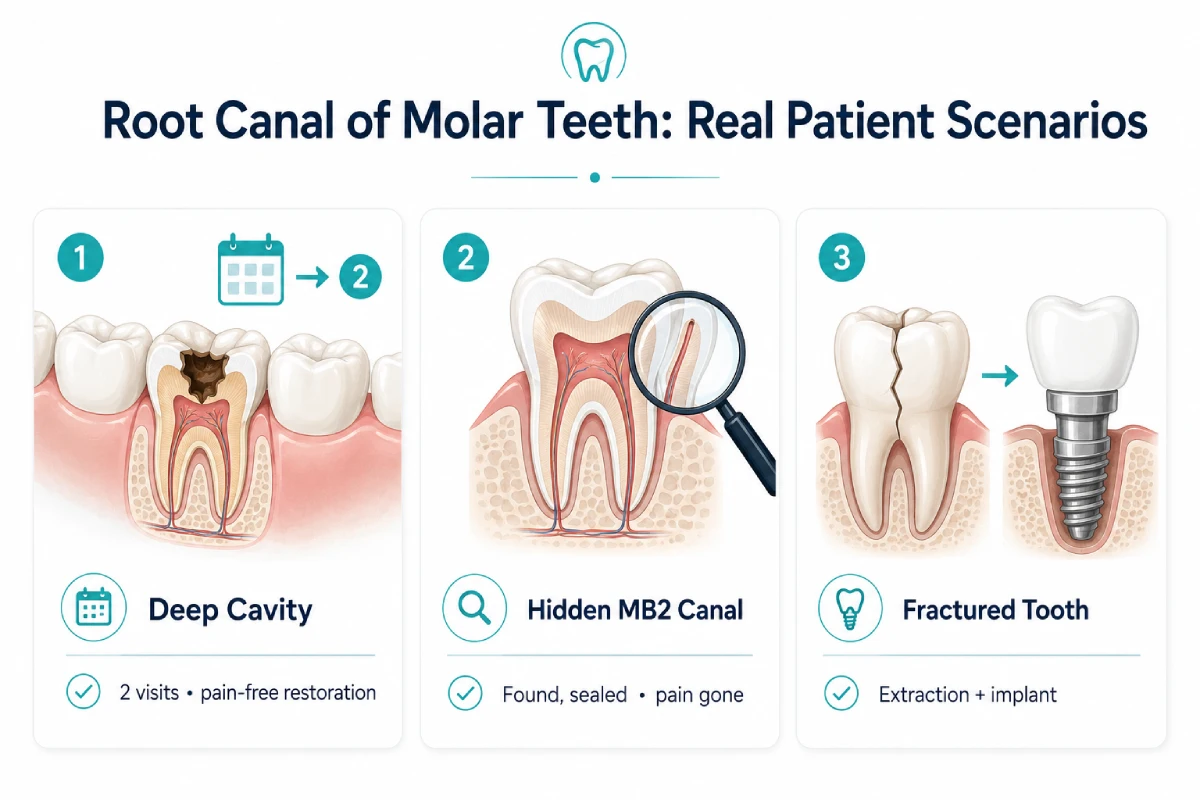
Real Patient Scenarios
Here are real scenarios of patients’ root canal retreatment:
Case 1: Deep Cavity in a Lower First Molar
A patient arrived with severe sensitivity. Our endodontist identified deep decay reaching the pulp. Due to the infection, we completed the treatment in two visits to ensure thorough cleaning and healing, resulting in a pain-free, fully restored tooth.
Case 2: Complex Upper Molar with a Hidden Canal
This patient had persistent discomfort despite previous treatment attempts elsewhere. Using high-powered magnification, we discovered a hidden MB2 canal that had been missed. After cleaning and sealing this extra canal, the chronic pain disappeared completely.
Case 3: When Extraction Was the Best Path
In one instance, a molar had a fracture extending below the gum line. After a careful assessment, we determined the tooth could not be saved reliably. We discussed the benefits of an implant as a long-term, stable solution, and the patient successfully moved forward with the extraction and replacement process.
What Endodontists Watch for in Molar Treatment
When treating molars, the biggest challenge is finding every single canal. Missed canals, especially the hidden MB2 canal in upper molars, are a leading cause of treatment failure. This is why using a dental microscope is vital; it allows the dentist to see tiny, complex structures that are otherwise invisible. If these tools are combined with CBCT 3D imaging, it allow for precise, predictable outcomes, ensuring that no infection is left behind and your natural tooth stays healthy for years to come.
Patient Reviews & Testimonials
Our patient, Gurpreet Sandhu, stated that:
“I had a fantastic experience at the dental clinic. Three months ago, my teeth were in pretty bad ,but Dr. Farahnaz Alavi and her team took great care of me. They performed a root canal treatment, which went smoothly, and I felt comfortable throughout the entire process. Dr. Alavi also did fillings for my other teeth, and everything was done with great skill. The staff is incredibly kind and professional. Anse, the assistant, was very helpful and made sure I was well taken care of. Niki, the receptionist, was always friendly and made scheduling easy. I highly recommend this clinic for anyone looking for excellent dental care.”

Need a Molar Root Canal in Vancouver?
If you have ongoing molar pain, sensitivity, swelling, or signs of an infected tooth, a dental exam can help determine whether root canal treatment is needed.
At Hemlock Dental Clinic, we can examine the tooth, review your X-rays, explain the expected molar root canal cost, and discuss what to expect during treatment and recovery. Contact our Vancouver dental clinic to book an appointment.
FAQs
Why does a molar root canal take longer?
Molars have more roots and canals than front teeth, requiring additional time to locate, clean, and seal each canal properly.
Can a wisdom tooth get a root canal?
Yes, but extraction is often preferred for wisdom teeth because their location makes treatment difficult and they are not essential for chewing.
Will my molar look different after a root canal?
With a properly fitted crown, your treated molar will look natural and match your surrounding teeth.
Can I chew on a treated molar?
Wait until the permanent crown is placed before resuming normal chewing on that side to prevent damaging the temporary filling.
How long will a root-canaled molar last?
With proper crown restoration and good oral hygiene, a treated molar can last a lifetime.
Can I skip the crown if my tooth feels fine?
No, molars require crowns after root canal treatment because of the high chewing forces that can fracture the weakened tooth structure.
Is a molar root canal worth the cost?
Yes, preserving your natural tooth is more cost-effective long-term than extraction and implant placement.
Can I get a same-day root canal in Vancouver?
Many dental clinics in Vancouver offer same-day molar root canal treatment for emergency cases.
Does insurance cover molar root canals?
Most dental insurance plans cover 50 to 80 percent of root canal treatment costs as it is considered a necessary procedure.
What if the dentist finds an extra canal during the procedure?
The dentist will treat the additional canal to ensure complete infection removal, which may add 15 to 30 minutes to the procedure time.
For comprehensive root canal treatment in Vancouver, contact us.
How many appointments does a molar root canal take?
A molar root canal may be completed in one appointment, but some cases need more than one visit. It depends on the number and shape of the canals, the condition of the tooth, and whether previous root canal treatment has been done.
When can I eat after a molar root canal?
Wait until the numbness has completely worn off before eating. After that, choose softer foods and avoid chewing hard or sticky foods on the treated molar, especially if you have a temporary filling.