Mini dental implants can be a practical option if your lower denture moves when you eat or speak, you have limited jawbone, or you want a less invasive treatment than standard implants. They are smaller, often easier to place, and usually cost less. But they aren’t a one-size-fits-all solution. If you grind your teeth, need support in a high-bite-force area, or want a long-term fixed solution, regular implants may be the better choice.
Key Facts About Mini Dental Implants
- Mini dental implants are usually less than 3 mm in diameter.
- Dentists commonly use them to stabilize loose lower dentures.
- Placement may require less surgery than standard implants.
- Some patients can use their denture on the same day.
- Mini dental implants cost less in many cases.
- They do not suit every bite, bone type, or tooth position.
- Current research supports their use most strongly for lower overdentures.
What Are Mini Dental Implants?
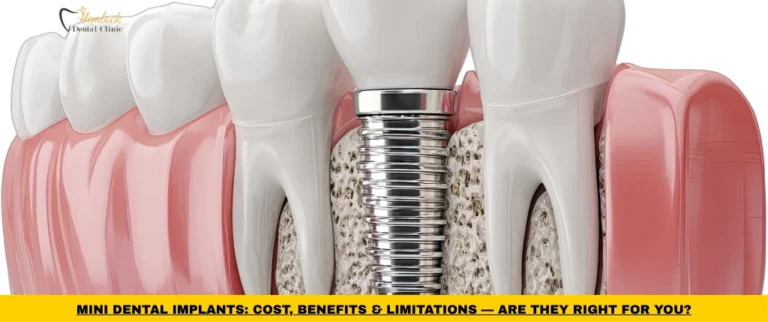
Mini dental implants Vancouver are narrow titanium posts that sit inside the jawbone and help support a denture or replacement tooth.
Many mini implant systems use a one-piece design. The top of the implant has a small ball-shaped attachment, and the denture contains an O-ring that snaps over it. This connection helps stop the denture from lifting or sliding during everyday use. Because the implant is narrow, the dentist may be able to place it through a small opening in the gum. This can mean less tissue disruption and a simpler recovery for some patients.
Mini Dental Implants Uses
Dentists most often use mini implants to stabilize lower dentures. They will consider them when the ridge is too narrow for a regular implant or when a patient wants to avoid more extensive bone grafting.
Research published in 2025 found that mini implants can provide good survival and patient satisfaction when they support overdentures, especially in the lower jaw. Results in the upper jaw were less predictable.
Mini Dental Implants vs Regular Implants
Patients often ask about mini dental implants vs regular implants because both can improve denture stability, but they are not interchangeable. Factors such as standard implant surgery costs are different.
| Feature | Mini Dental Implants | Regular Implants |
|---|---|---|
| Diameter | Usually under 3 mm | Usually wider |
| Design | Often one-piece | Usually implant plus abutment |
| Surgery | Often less invasive | May require a wider surgical site |
| Bone grafting | May be avoided in some cases | More likely with limited bone |
| Loading | Can sometimes be immediate | Often requires healing first |
| Cost | Usually lower | Usually higher |
| Best use | Denture stabilization, narrow spaces | Single teeth, bridges, overdentures, fixed teeth |
| Bite forces | More limited in some cases | Better suited to heavier forces |
| Long-term evidence | Good but more limited | More extensive |
A 2024 systematic review found that mini implants can be an alternative for retaining mandibular overdentures. Standard implants showed slightly higher survival in the studies that directly compared the two, although both treatments improved quality of life.
If you want to understand the wider range of options, our guide to dental implants Vancouver explains standard implant treatment in more detail.
Who Are Mini Dental Implants Good For?
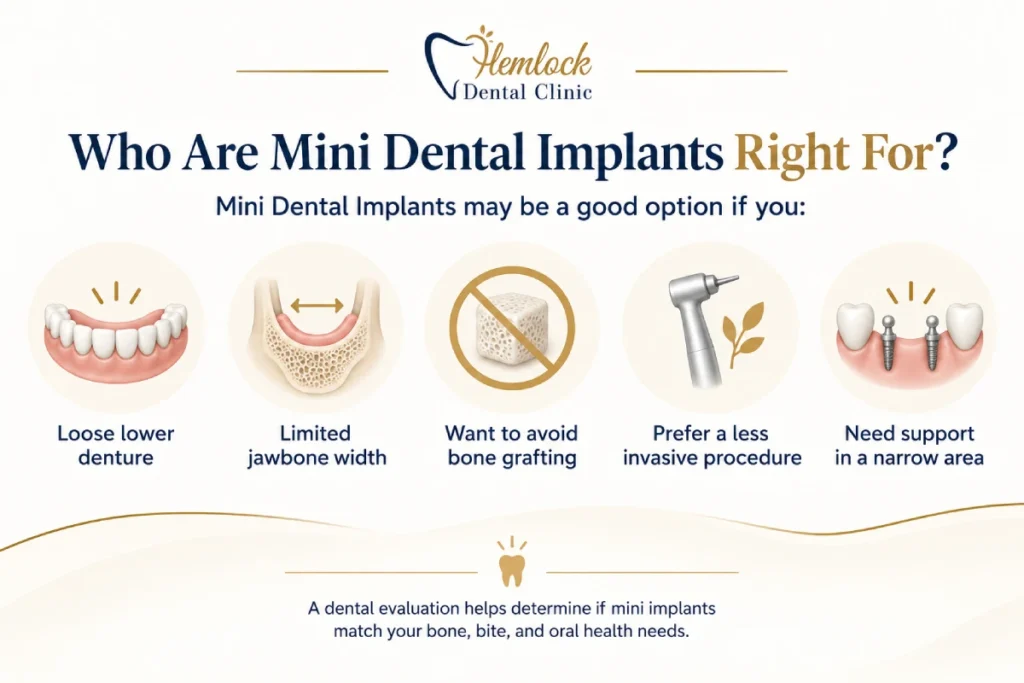
According to Mini dental implant clinical guidelines, they can make sense when the main problem is a loose denture rather than the need for a fully fixed set of teeth. Dr. Alavi may consider them if you:
- have a loose lower denture;
- have limited bone width;
- want to avoid bone grafting where possible;
- prefer a less invasive procedure;
- have medical concerns that make larger surgery less desirable;
- need an implant in a narrow area.
For some people, this can be a much simpler way to make an uncomfortable denture feel more secure.
Who Is Better With Regular Implants?
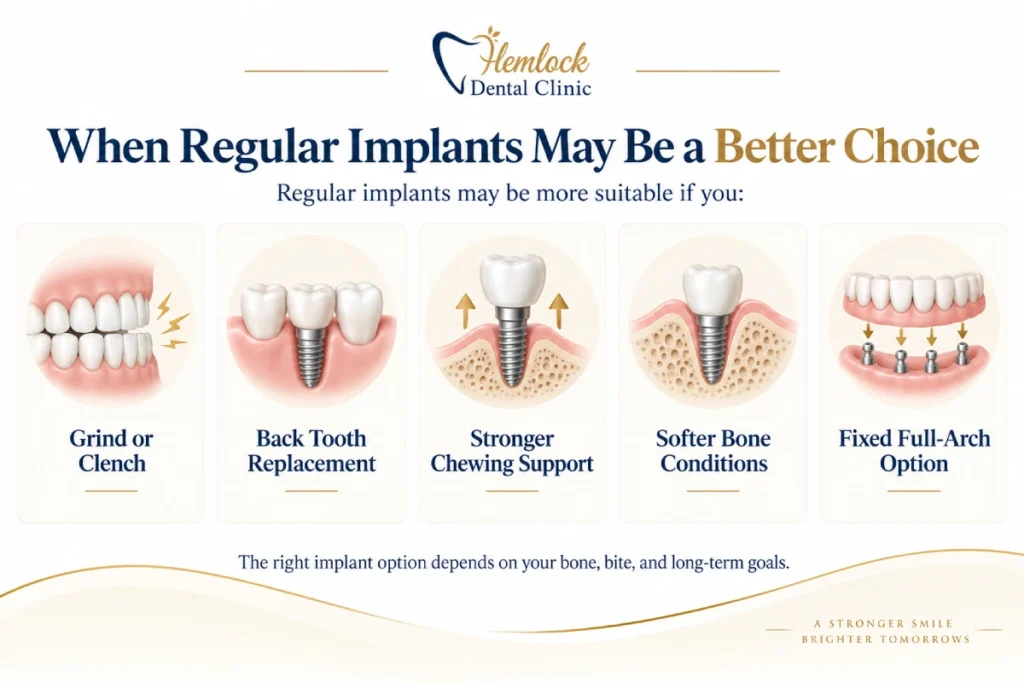
Mini implants are not automatically the right choice just because they are smaller or cheaper. Standard implants may be more appropriate if you:
- grind or clench heavily;
- need to replace a back tooth;
- need to handle stronger chewing forces;
- have very soft bone;
- want a fixed full-arch restoration;
- want the treatment with the broadest long-term evidence.
Studies also suggest that narrow implants and mini implants perform more predictably in the lower jaw than in the upper jaw.
The decision should come from your bone quality, bite, denture design, medical history, and long-term goals, not from implant size alone.
What Happens During the Procedure?
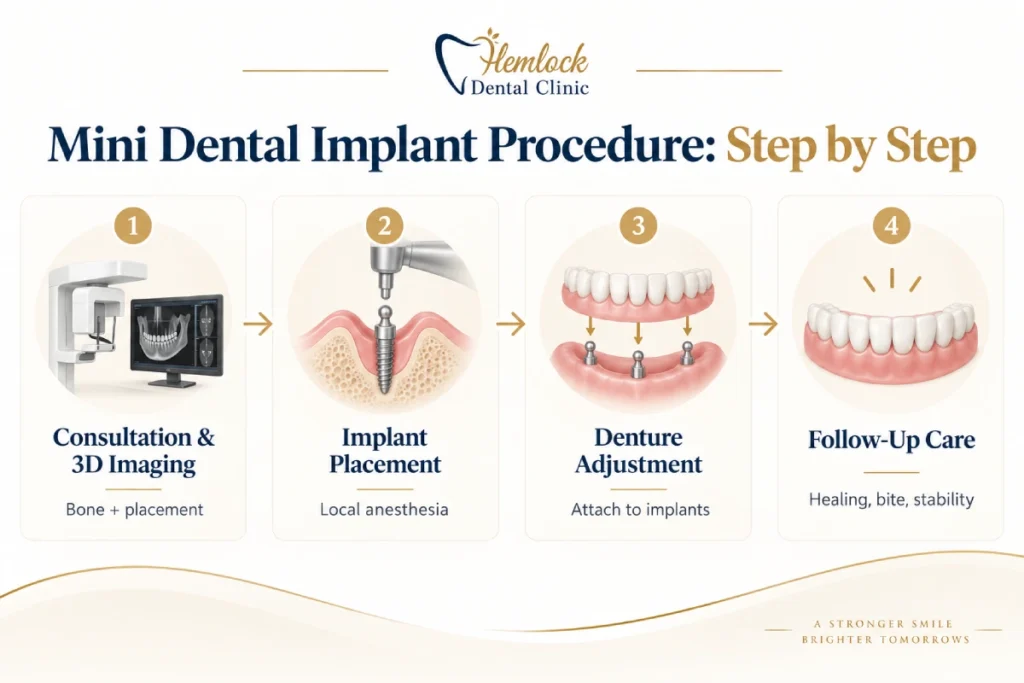
The process is often simpler than patients expect. Dr. Alavi first examines your mouth and reviews your X-rays or 3D scan. This shows how much bone is available and where the implants can sit safely.
After local anesthetic, she places the mini implants into the jaw. Because they are narrow, large gum incisions may not be necessary.
If the implants are stable enough, your denture may be adjusted to snap onto them the same day. You will still need follow-up appointments so the dentist can check healing, your bite, and the attachments.
Mini Dental Implants Cost in Vancouver
Mini dental implants cost less than regular implants in many cases, but there is no single fixed fee. Current Vancouver and British Columbia estimates place mini implants at around $1,500 to $2,500 CAD per implant.
That means four mini implants will cost: $6,000 to $10,000 CAD for the implants alone.
Your final price may change if you also need:
- a new denture;
- denture modification;
- 3D imaging;
- extractions;
- laboratory work;
- additional follow-up care.
For comparison, a complete standard single-tooth implant in Vancouver can fall around $3,900 to $5,500, depending on the clinic and treatment needed.
The lower upfront price is attractive, but cost should not be the only reason to choose minis. A treatment that does not match your bite or bone can cost more later if it needs repair or replacement.
Before treatment, ask for a written estimate and check whether private insurance or CDCP may cover part of your care.
Ask Dr. Alavi:“My Lower Denture Is Loose, but I Was Told I Don’t Have Enough Bone. Should I Choose Minis or Bone Grafting?”
If your main goal is to stop a lower denture from moving, mini implants may be worth considering.
They can sometimes provide enough retention without the extra step of bone grafting.
However, if you want stronger support or a more fixed restoration, grafting followed by standard implants may still offer the better long-term plan. There is no one-size-fits-all answer. Dr. Alavi will look at your bone width, bone density, bite, health, current denture, and what you want from treatment.
You can also compare this option with implant-supported dentures if your main goal is a more stable denture.
Ask Dr. Alavi: “What Happens If a Mini Implant Fails?”
A failed mini implant usually needs to be removed. What happens next depends on the condition of the bone. Sometimes another mini implant can go into a different position. In other cases, the area needs time to heal before the dentist considers a new implant, grafting, or a standard implant.
The encouraging part is that current evidence shows good short- and medium-term survival for mini implants used with lower dentures. A 2025 review reported an estimated seven-year survival rate of about 91%, although researchers also found more failures in the upper jaw. This is why careful case selection matters.
Are Mini Dental Implants Right for You?
Mini dental implants can be a good solution for the right patient, especially if a loose lower denture affects eating, speaking, or confidence. They may also help if you have limited bone or want to avoid a more extensive procedure.
But cheaper and smaller do not automatically mean better. The best treatment depends on your bone, bite, health, and what you expect from your new teeth. Not sure whether mini implants, regular implants, or a snap-in denture make more sense? Ask Dr. Alavi at Hemlock Dental Clinic if mini implants are a fit for your case and book a consultation.
FAQs
Are mini dental implants as strong as regular implants?
Not usually. Their smaller diameter limits how much force they can handle in some situations. Regular implants are often more suitable for back teeth, heavy biting forces, and larger fixed restorations.
Do mini implants require bone grafting?
Not always. Their narrow size means they can sometimes fit into areas where a regular implant would need more bone. You still need enough healthy bone to keep the implant stable.
How long do mini dental implants last?
Many last for years. Research shows good survival rates for lower overdentures, but standard implants still have a larger body of long-term evidence.
How long does recovery take?
Many patients experience only mild soreness for a few days. Recovery can feel easier because placement may involve less gum and bone surgery.
Can Mini Dental Implants Hold a Full Set of Fixed Teeth?
Mini implants are most commonly used to stabilize removable dentures. If you want a full set of fixed teeth, standard implants usually offer a more established option for handling higher forces.