When people want to choose the best method to make their smile more beautiful, they want to know all the details about veneers vs crown. A veneer is for looks only; it covers just the front of a tooth. A crown fixes a weak or damaged tooth. It covers the whole tooth. Veneers are thinner (~1mm) and cost less. Crowns are thicker (~2mm) and stronger. Veneers cover only the front surface. Crowns cover the entire tooth. Generally, veneers are cosmetic. Crowns are restorative first. But crowns can also improve appearance. In this article, we will find out more details about cosmetic dentistry Vancouver.
Veneers vs Crowns: Side-by-Side Comparison Table
Here is everything you need to compare.
| Factor | Veneers | Crowns |
|---|---|---|
| Coverage | Front surface only | Entire tooth |
| Thickness | ~1 mm | ~2 mm |
| Tooth prep needed | Minimal (~0.5 mm enamel) | Significant (~60-75% of tooth) |
| Primary purpose | Cosmetic | Restorative + cosmetic |
| Best for | Healthy teeth | Damaged/weak teeth |
| Materials | Porcelain, composite | Porcelain, ceramic, metal, PFM, zirconia |
| Lifespan | 10-20 years | 10-20+ years |
| Cost per tooth | 900−900−2,500 | 1,000−1,000−3,500 |
| Insurance coverage | Usually NOT covered | Often covered (50-80%) |
| Procedure visits | 2-3 | 2-3 |
| Reversibility | No (porcelain) | No |
| Used on back teeth? | Rarely | Yes |
| After root canal | Not suitable | Standard choice |
| Tooth strength after | Same as natural | Strengthened |
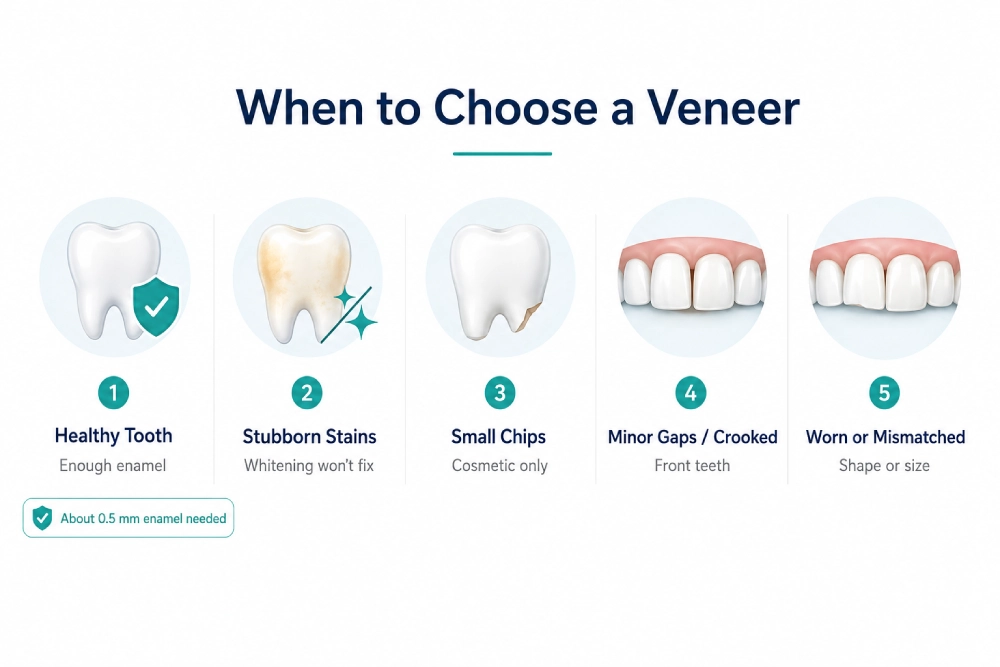
When Should You Choose a Veneer?
Go for a veneer when your tooth is healthy but looks bad. You need enough enamel left. About 0.5mm of healthy enamel to bond to.
- Mild discoloration that whitening can’t fix
- Small chips or cracks (cosmetic only)
- Slightly crooked or uneven teeth
- Gaps between front teeth (diastema)
- Worn-down edges (mild cases)
- Mismatched tooth shapes or sizes
When Should You Choose a Crown?
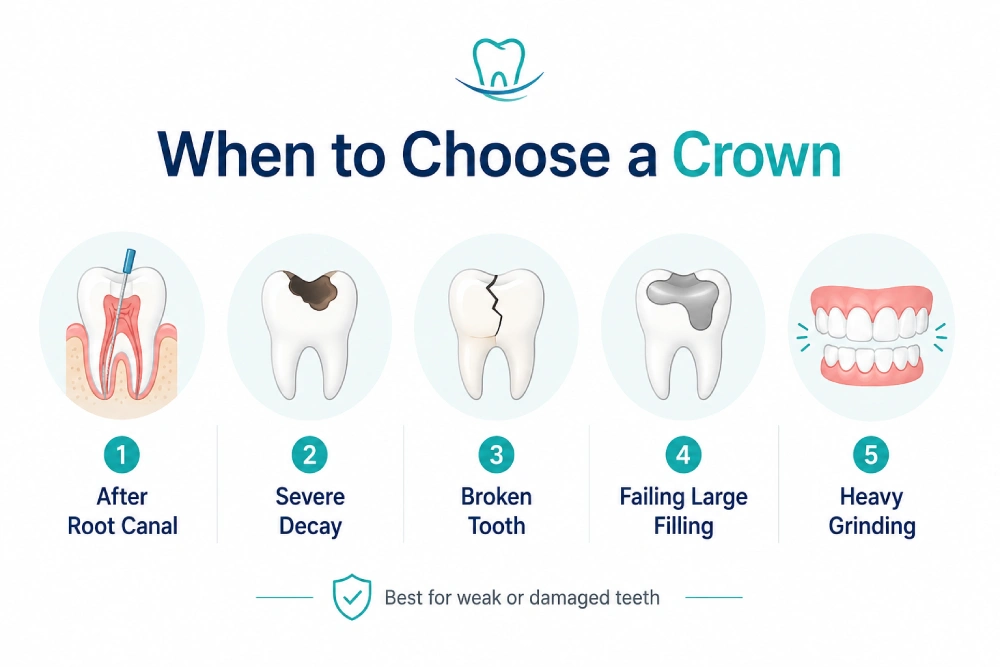
To choose crown vs veneer remember that they are for teeth that need help staying alive. If your tooth is broken or weak, do not get a veneer. Get a crown.
- After a root canal (teeth become brittle)
- Severely decayed tooth
- Broken or fractured tooth
- Large filling that is failing
- Tooth with significant structural loss
- Dental implant top (the visible part)
- Heavy grinder or clencher
- Tooth shaped abnormally (genetic)
Veneer or Crown: A Decision Guide by Situation
If you do not know how to choose veneers teeth or crown, compare your situation with these facts:
| Your Situation | Better Choice | Why |
|---|---|---|
| Just stained teeth, healthy tooth | Veneer | Less invasive |
| Chipped front tooth (small chip) | Veneer | Cosmetic concern |
| Chipped front tooth (large chip) | Crown | Needs structural support |
| After root canal on molar | Crown | Requires strength |
| After root canal on front tooth | Crown OR veneer | Depends on damage level |
| Cracked tooth | Crown | Full coverage protection |
| Gap between front teeth | Veneer | Cosmetic adjustment |
| Severely worn back teeth | Crown | Restore function |
| Genetically small front teeth | Veneer | Reshaping cosmetically |
| Tooth with large old filling | Crown | Structural backup needed |
Cost Comparison: Veneers vs Crowns
Money matters. According to American Dental Association’s cost guide, here is what you will actually pay, and how much is veneers teeth:
- Porcelain veneer: 900−900−2,500 per tooth
- Composite veneer: 250−250−1,500 per tooth (shorter life)
- Porcelain/ceramic crown: 1,000−1,000−3,500 per tooth
- PFM or metal crown: 600−600−2,500 per tooth
Most dental insurance covers crowns at 50-80%. Veneers? Rarely. Because veneers are cosmetic. The exception is injury from an accident.
Long-term cost: Both last 10-20 years. But replacing a crown later costs the same again. Veneers too.
Procedure Differences: What to Expect
The big difference between veneers vs crown is how much tooth gets shaved down.
Veneer Procedure (2-3 visits)
- Numb the area (sometimes not even needed)
- Shave off ~0.5mm of enamel from the front only
- Take a mold or digital scan
- Temporary veneer placed (maybe)
- Lab makes your permanent veneer
- Bond it on with strong cement
Crown Procedure (2-3 visits)
- Numb the tooth completely
- Shave off 1.5-2mm from ALL sides of the tooth
- Build up the core if tooth is weak
- Take a mold or scan
- Temporary crown placed (always)
- Permanent crown cemented at next visit
Lifespan and Durability
How long will your money last?
- Porcelain veneer: 10-20 years
- Composite veneer: 5-7 years (cheaper but shorter)
- Porcelain crown: 10-20+ years
- Zirconia crown: 15-25 years (very strong)
- Metal or PFM crown: 15-30 years
What shortens life? Grinding teeth, biting hard things, poor oral hygiene, and smoking.
Appearance: Which Looks More Natural?
Both can look amazing, but there is a difference:
Veneer advantages:
- More translucent like real enamel
- Less gray line at the gum margin
- Better for single front tooth repairs
Crown advantages:
- Modern porcelain crowns look very natural
- Can match adjacent teeth well
- Zirconia crowns have no metal darkening
The catch with crowns? Sometimes you see a thin line at the gum over time. Veneers hide this better.
Tooth Preparation: How Much Enamel Is Removed?
This is the biggest practical difference:
- Veneer: ~0.5 mm removed from the front surface only
- Crown: 1.5-2 mm removed from all sides (60-75% of the whole tooth)
Once enamel is gone, it is gone forever. So if a veneer fails later, you cannot just “go back.” You will need another veneer or a crown.
Veneer or Crown After a Root Canal?
Almost always a crown. Here is why. A root canal kills the nerve and blood supply. The tooth dries out. Becomes brittle. It will crack without full coverage.
- Molar or premolar after root canal: Crown is the best option.
- Front tooth after root canal: Crown OR veneer. Depends on how much tooth is left. But most dentists still say crown.
Never get a veneer on a back tooth that has had a root canal. It will break within a year.
Insurance and Veneers vs Crowns
Know what your plan will pay before you start.
| Treatment | Insurance Coverage |
|---|---|
| Veneer (cosmetic) | Usually 0% |
| Crown (functional need) | Often 50-80% |
| Crown after root canal | Often covered fully after the deductible |
| Veneer for accident damage | Sometimes partial (call first) |
If your dentist writes “medical necessity,” a crown gets covered. Veneers rarely qualify. Do not try to have a veneer a crown. Insurance companies will check and tell you.
Pros and Cons of Each: Veneers vs Crown
Here is the list of each one’s pros and cons:
| Veneers | Crowns | |
|---|---|---|
| Pros | Less invasive, saves more enamel, very natural looking | Stronger, protects weak teeth, insurance often covers it |
| Cons | Cosmetic only, no structural support, rarely insured | More tooth removed, slightly less natural at gum line, costs more upfront |
Can You Get a Crown on a Front Tooth?
Yes. People do it all the time. You need a front tooth crown when you have:
- Severe damage (half the tooth is gone)
- After a root canal on a front tooth
- A veneer cannot hold because not enough enamel is left
Modern porcelain crowns on front teeth look almost identical to veneers. Your friends will not know.
Can You Get a Veneer on a Back Tooth?
Can you use crown vs veneer on back tooth? Usually no. Here is why:
Back teeth take +200 pounds of force when you chew. Veneers are thin and can crack. A broken veneer on a molar means redoing everything.
Exception: Palatal veneers for wear on the inside surface of upper front teeth. But that is rare. For molars you can get a crown.
What If I Need Both?
Many smile makeovers use both, one size does not fit all.
Example: Front six teeth get veneers for a perfect smile. Two broken back molars get crowns for chewing. Your dentist will make a comprehensive treatment plan. Do not force one option on every tooth.
Real Patient Scenarios
Case 1: Front tooth chip, healthy underneath
A 34-year-old woman chipped her front incisor on a fork. The tooth was otherwise healthy. We did one porcelain veneer. Cost $1,800. Lasted 12 years so far. She forgets which tooth it is.
Case 2 : Cracked molar from grinding
A 52-year-old man ground his teeth for decades. His lower first molar had cracks extending into the gum line. No veneer could fix that. We did a zirconia crown. Cost $2,400. Insurance paid 60%. Five years later, still perfect.
Case 3: Stains + small cracks on multiple teeth
A 41-year-old woman hated her smile. Stains from old tetracycline. Small cracks on four front teeth. She got four porcelain veneers. And one crown on a tooth with a large old filling. Mix of both. Total cost $11,000. She smiles in every photo now.
What Dentists Consider Before Recommending Each
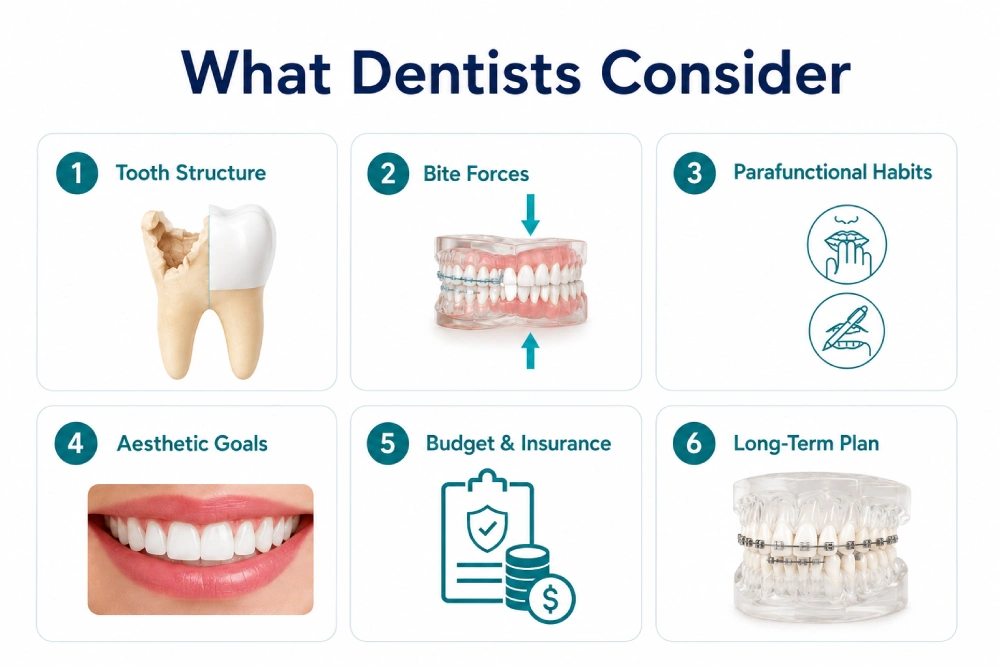
Every dentist checks these things when choosing crown vs veneer:
- Tooth structure remaining: Less than 50% left? Crown.
- Bite forces: Heavy grinder? Crown on back teeth.
- Parafunctional habits: Nail biter? Pen chewer? Veneers may fail.
- Aesthetic goals: Hollywood smile? Veneers. Just fix one tooth? Either.
- Budget and insurance: Crown if insurance helps. Veneer if you pay cash.
- Long-term plan: Plan to get braces later? Wait on veneers.
Patient Reviews & Testimonials
Our patient, Aren Abdolmaleki, stated that:
“I highly recommend this place. I gave up places near me and bike here all the way from North Van and it’s worth it. Dr Alavi is precise, doesn’t cut corners, and I trust that she cares about me. The staff are also amazing and awesome to deal with. I did a crown here and it went smoothly from start to finish.”

FAQs
Is a crown stronger than a veneer?
Yes. Much stronger. Crowns handle full chewing force, Veneers are for front teeth only.
Can a veneer become a crown later?
Yes. If a veneer fails, your dentist can remove it and put a crown on the same tooth. But you cannot go back from crown to veneer.
Which lasts longer, veneer or crown?
Metal crowns last longest (up to 30 years). Porcelain veneers and porcelain crowns both last 10-20 years. About the same.
Can I switch from a crown to a veneer?
No. Once you get a crown, too much of the tooth is gone. A veneer would not stick.
Do crowns or veneers look more natural?
Veneers look slightly more natural at the gum line. But a good porcelain crown on a front tooth is very close.
Why do crowns cost more than veneers?
More materials. More lab time. More tooth prep. And crowns restore function, not just looks.
Will my dentist recommend the cheaper option?
Good dentists recommend what works, not what is cheap. A cheap veneer that breaks costs more in the end.
Can I get veneers if I grind my teeth?
Only if you wear a nightguard every single night. Otherwise, veneers will crack. Get crowns on grinding teeth.
Are crowns more painful to get than veneers?
About the same. Both use local freezing. The crown prep takes longer, but pain is not worse.
Can crowns and veneers be on the same tooth?
No. One tooth gets one treatment. You choose.
Will my insurance pay for a veneer if I call it a crown?
No. Do not try this. Insurance companies’ audit records. They will deny and drop you.
How do I know if I need a veneer or a crown?
See a dentist for an exam and X-ray. If the tooth is healthy and you want better looks, veneer. If the tooth is weak, broken, or has a big filling, crown. Do not guess.