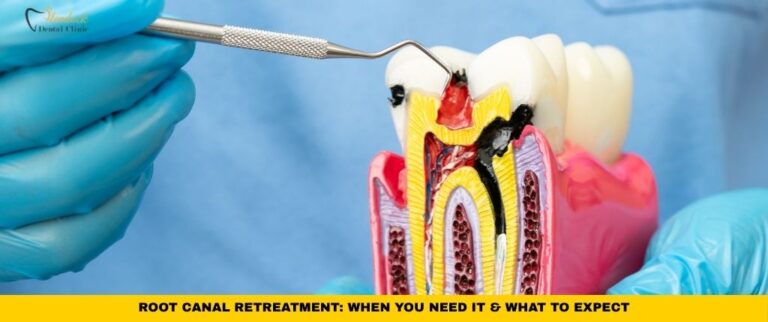
Root canal treatment Vancouver is a second procedure performed when a previous root canal fails or the infection returns. Dentists reopen the tooth, remove the old filling material, clean the canals again, and reseal them. According to the American Association of Endodontists, root canal retreatment has a success rate of about 75–80% depending on the condition of the tooth and surrounding bone. In this article we will find out more details.
What Is Root Canal Retreatment?
Root canal retreatment is a procedure done to fix a tooth that didn’t heal properly after a previous root canal. In dentistry, this is called endodontic retreatment. The dentist reopens the tooth, removes the old filling materials, carefully cleans the canals again, and seals them to prevent further infection. Although it may sound complex, the goal is simple: give your tooth a second chance to heal and function normally.
Why Would a Root Canal Need Retreatment?
A root canal can fail for different reasons, even if the original treatment was done carefully. Teeth are complex and canals can be very narrow, curved, or hidden. Some common reasons for needing root canal retreatment include:
- Missed canals in the first treatment, especially very narrow or curved ones.
- New decay that forms around the filling or crown and lets bacteria back inside.
- A cracked or loose crown or filling that allows leakage.
- Delaying the crown after the first root canal, leaving the tooth unprotected for too long.
- A new fracture or crack in the tooth after trauma or biting something hard.
- Contamination from saliva if the tooth was not properly sealed.
Signs You Might Need a Root Canal Retreatment
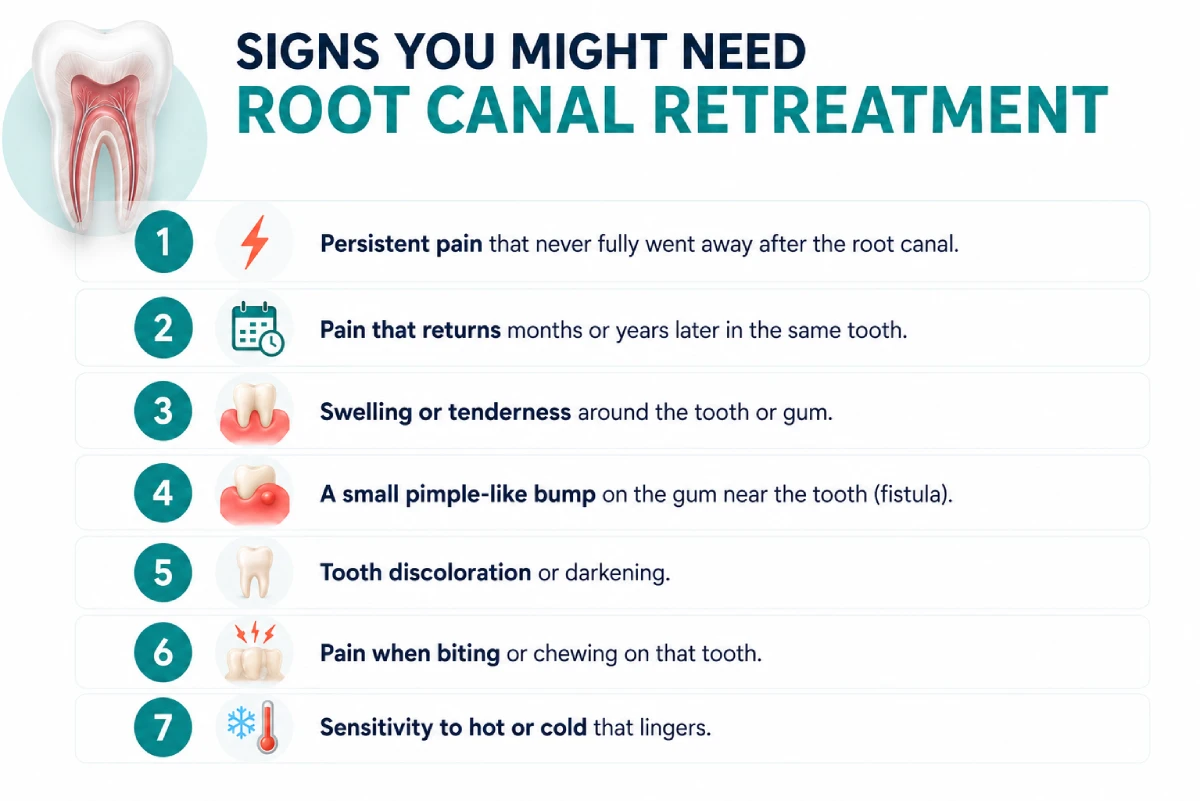
If you’ve had a root canal in the past and notice any of these signs such as pain, bump or inflammation, you will need retreatment. Typical symptoms include:
- Persistent pain that never fully went away after the root canal.
- Pain that returns months or years later in the same tooth.
- Swelling or tenderness around the tooth or gum.
- A small pimple-like bump on the gum near the tooth (fistula).
- Tooth discoloration or darkening.
- Pain when biting or chewing on that tooth.
- Sensitivity to hot or cold that lingers.
If you recognize these symptoms, it’s a good idea to book an appointment at a dental clinic in Vancouver for a proper diagnosis.
How Soon After a Root Canal Can Problems Appear?
Problems after a root canal can appear at very different times. For some people, symptoms return within days or weeks. For others, the tooth feels fine for years before issues show up.
This timing matters because early problems may be because of remaining infection or technical issues with the original treatment, while later problems are often caused by new decay, a leaking crown, or a crack in the tooth. Regular checkups make it easier for your dentist to catch small changes before they turn into bigger infections.
The Root Canal Retreatment Procedure: Step-by-Step
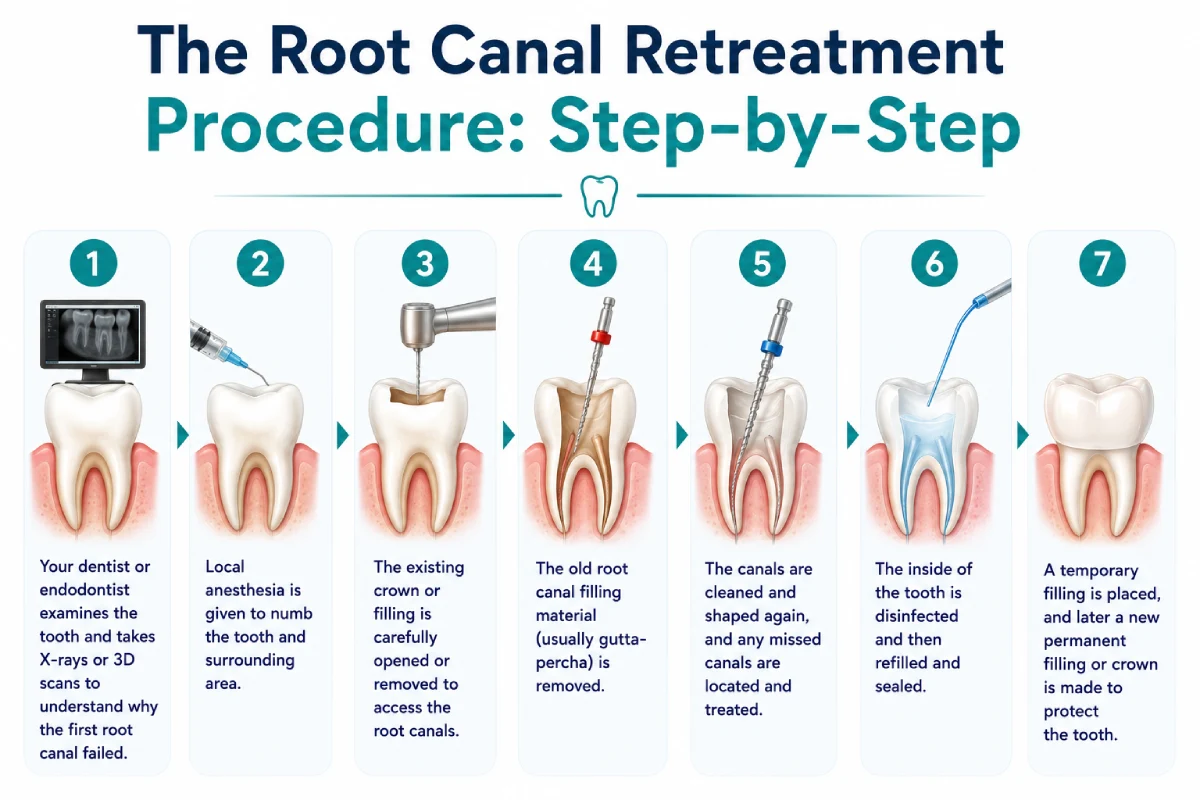
The procedure is usually very similar to your first root canal and is done under local anesthesia. Here are the steps:
- Your dentist or endodontist examines the tooth and takes X-rays or 3D scans to understand why the first root canal failed.
- Local anesthesia is given to numb the tooth and surrounding area.
- The existing crown or filling is carefully opened or removed to access the root canals.
- The old root canal filling material (usually gutta-percha) is removed.
- The canals are cleaned and shaped again, and any missed canals are located and treated.
- The inside of the tooth is disinfected and then refilled and sealed.
- A temporary filling is placed, and later a new permanent filling or crown is made to protect the tooth.
Most root canal retreatment cases are completed in one to three visits, depending on how complex the tooth is.
Retreatment vs Apicoectomy: What’s the Difference?
Retreatment works from inside the tooth, while an apicoectomy is a small surgery done through the gum near the root tip. Here are more details:
| Factor | Retreatment (Endodontic Retreatment) | Apicoectomy (Endodontic Surgery) |
|---|---|---|
| Approach | Inside the tooth, through the existing filling or crown | Through the gum, removing the tip of the root |
| When recommended | General retreatment needs, when canals may have been missed or not fully cleaned | When infection is limited to the root tip or persists after retreatment |
| Invasiveness | Non-surgical procedure | Minor surgical procedure |
| Recovery | Usually about 1–3 days of mild soreness | Usually about 3–7 days of localized soreness and gum healing |
| Success rate | Around 75–80% in suitable cases | Around 85–90% in well-selected cases |
Retreatment vs Extraction: Which Is Better?
Many patients think if they should just remove the tooth instead of going through retreatment. It’s a fair question.
In most cases, dentists prefer to save your natural tooth whenever it is possible. A tooth that can be successfully retreated and well restored can last for many years and keeps your bite, smile, and jawbone stable.
Extraction might be recommended if the tooth is badly cracked, has very poor remaining structure, or if the surrounding bone is severely damaged.
Here is a simple way to compare the two options over the long term:
| Factor | Retreatment | Extraction + Implant |
|---|---|---|
| Preserves natural tooth | Yes | No |
| Total cost | Usually moderate | Usually highest |
| Treatment duration | 1–3 visits over a short period | Several stages over 3–6 months |
| Bone preservation | Natural root keeps bone stimulated | Initial bone loss after extraction, then support from implant |
Root Canal Retreatment Success Rate
We can say that no treatment offers a 100% guarantee, but retreatment can be very successful when it is done under the right conditions. According to valuable studies:
- First-time root canal treatments have success rates around 90–95% in many studies.
- Root canal retreatment usually has success rates around 75–80%.
- A second retreatment (a third overall treatment on the same tooth) often has a lower success rate and is only recommended in selected cases.
Your individual success rate depends on the shape of the roots, the amount of remaining tooth structure, the health of the bone around the tooth, and the quality of the final crown or filling. Your dentist or endodontist will explain whether retreatment is a strong option in your specific case.
How Many Times Can a Root Canal Be Retreated?
Most of the time, a tooth is retreated once, and that is usually enough. In some cases, you will need a second retreatment, but it is less common. Each time the tooth is reopened, a little more structure is removed, and that can weaken the tooth. Because of this, if retreatment fails again, dentists often suggest an apicoectomy or extraction as the next step.
How Much Does Root Canal Retreatment Cost?
Root canal retreatment is usually more complex than the first root canal, so it is more expensive. Costs depend on:
- The type of tooth: front teeth are usually simpler and less expensive, while molars with multiple roots cost more.
- The need for a new crown or build-up.
- Whether the treatment is done by a general dentist or an endodontist.
Retreatment may be around 20–30% more expensive than the first root canal on the same type of tooth. Many dental insurance plans in Canada cover part of the fee, especially when retreatment helps you avoid extraction and more extensive work later. At a dental clinic in Vancouver, you should receive a clear treatment plan and cost estimate before you decide.
Recovery After Root Canal Retreatment: What to Expect
For the first day to three days, you may notice mild soreness, especially when chewing or biting down on the tooth. This usually responds well to over-the-counter pain medication recommended by your dentist.
By days four to seven, most people feel close to normal again. The final crown is usually placed one to two weeks later, once your dentist is confident the tooth is healing well.
How to Prevent Future Root Canal Failure
Good after-care is just as important as the procedure itself. To reduce the chance of needing another retreatment, here are some tips:
- Have your permanent crown or final restoration placed as soon as your dentist recommends it.
- Brush twice a day and floss daily to prevent new decay.
- Keep regular dental checkups so small problems are found early.
- Avoid biting ice, hard candy, or other very hard foods with the treated tooth.
- If your crown or filling feels loose, chipped, or uncomfortable, book a visit promptly instead of waiting.
Real Patient Scenarios (Experience in Practice)
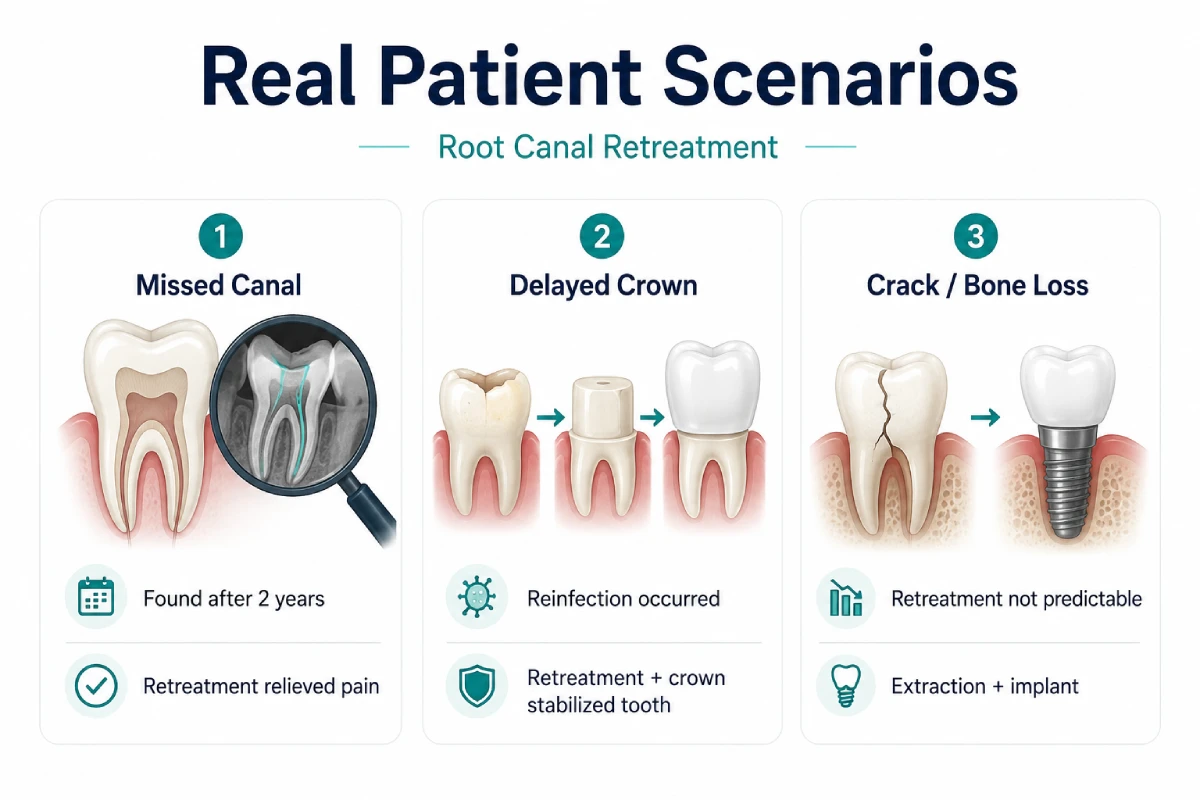
Case 1 – Missed canal found after two years
A patient came in with mild pain in a tooth that had a root canal two years earlier. X-rays and 3D imaging showed a narrow extra canal that had not been treated the first time. After retreatment including that canal, the symptoms resolved and the tooth remained comfortable at follow-up.
Case 2 – Delayed crown led to reinfection
Another patient felt fine after the first root canal, but delayed getting the crown for several months. During that time, the temporary filling wore down and bacteria leaked in. Retreatment was needed, followed by a properly fitted crown. The tooth then stayed stable and pain-free.
Case 3 – When retreatment was not possible
In some cases, the tooth has a crack below the gum line or severe bone loss. One such patient was advised that retreatment would not be predictable. The best option was extraction followed by an implant. Although it meant removing the tooth, the final result was a strong, natural-looking replacement.
What Endodontists See in Practice
Endodontists, specialists in root canal and root canal retreatment, often see patients who waited a long time after symptoms started because they were afraid of treatment or hoped the pain would go away on its own. By the time they arrive, the infection is larger or the tooth is more damaged than it needed to be.
Another common pattern is patients who never completed the final step, such as placing a crown, and the tooth failed because it was not properly sealed or protected. From the specialist’s point of view, early diagnosis and complete restoration make the biggest difference in long-term success.
If you need help in recognizing your problems, call us at Hemlock Dental Clinic.
FAQs
Is root canal retreatment more painful than the first time?
No. With modern anesthesia and techniques, retreatment usually feels very similar to the first root canal.
How long does retreatment take?
Many cases are finished in one or two visits, but more complex teeth may need a third visit.
Will my insurance cover retreatment?
Many dental insurance plans offer partial coverage for root canal retreatment, especially when it helps avoid extraction and replacement.
Can I just get the tooth pulled instead?
Extraction is always an option, but it leads to a gap that usually needs an implant or bridge if you want to chew normally and protect your bite.
How long will a retreated tooth last?
With good treatment and proper care, a retreated tooth can last many years.
What happens if retreatment fails?
If symptoms or infection return, your dentist may recommend an apicoectomy (endodontic surgery around the root tip) or, if the tooth cannot be saved, extraction with a suitable replacement option.
Can I see my regular dentist, or do I need an endodontist?
Some general dentists perform retreatments, but complex cases are often referred to an endodontist, who has advanced training and equipment for this type of work.
Is retreatment worth the cost?
For many patients, yes. Saving your natural tooth helps you avoid more extensive and expensive treatments like implants and bridges, and it keeps your bite and smile more natural.