
A deep cavity generally cannot heal on its own, but with a fast filling or a root canal, the tooth can be saved and further decay prevented. How can you heal a cavity? Early cavities can sometimes be stabilized or reversed with professional fluoride treatments, improved oral healthcare, and changes in diet; however, when a hole has developed, only a dentist can remove the decay and restore the tooth with a filling or other treatment. If you need quick help, fill out the form on this page or contact us now at Hemlock Dental Clinic at 604-738-9202.
What Is a Cavity?
A cavity in back tooth in general dentistry is permanent damage to your tooth that is caused by acids of bacteria that dissolve the hard enamel and dentin, and creates a hole. With the further course of the decay, the pulp (nerve and blood supply) may be exposed to infection, pain, and even an abscess.
Types of Cavities
- Pits and fissure cavities (on chewing surfaces),
- smooth-surface cavities (between teeth or along sides),
- root cavities (on exposed root surfaces in older adults or gum recession).
How to Heal Deep Cavity?
Here are some details to treat root canal cavity:
1.Early decay (and without a noticeable hole)
Early decay can sometimes be remineralized, but established cavities must be treated by a dentist.
To prevent or reverse the initial lesions, dentists apply fluoride toothpaste or varnish, sealants, and diet and home care education, which helps the enamel in healing with salivary and fluoride minerals.
Home interventions such as brushing with fluoride, daily flossing, lessening sugar, and saltwater rinses can decrease symptoms and slow the progression cannot eliminate an existing deep cavity or seal a hole.
2.Root cavity, deep cavity and back tooth cavities
Deep cavities, particularly in a back tooth or close to the root, need immediate professional attention to prevent infection or loss of teeth. A moderately deep cavity that has not reached the pulp can sometimes be filled using a dental filling, occasionally with pulp-capping agents to cover the nerve.
In case of such deep decay, in the root, root canal, or root under an old filling, your dentist might suggest a crown, root canal, or, if the tooth cannot be saved, extraction.
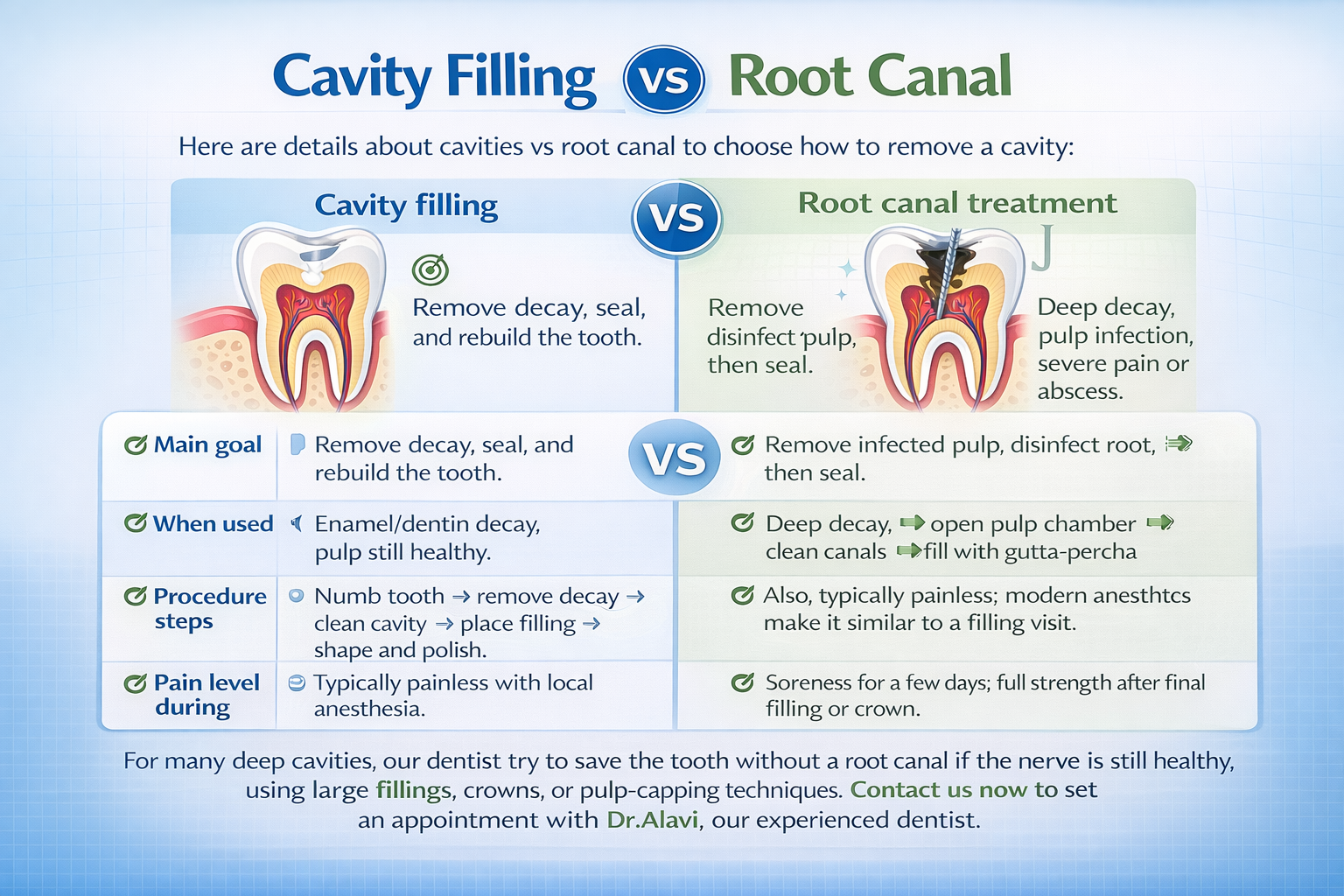
Cavity Filling vs Root Canal
Here are details about cavities vs root canal to choose how to remove a cavity:
| Aspect | Cavity filling | Root canal treatment |
| Main goal | Remove decay, seal, and rebuild the tooth. | Remove infected pulp, disinfect root, then seal. |
| When used | Enamel/dentin decay, pulp still healthy. | Deep decay, pulp infection, severe pain or abscess. |
| Procedure steps | Numb tooth → remove decay → clean cavity → place filling → shape and polish. | Numb tooth → open pulp chamber → clean canals → fill with gutta‑percha → often place a crown. |
| Pain level during | Typically painless with local anesthesia. | Also, typically painless; modern anesthetics make it similar to a filling visit. |
| Recovery expectations | Mild sensitivity for a few days; normal chewing soon after. | Soreness for a few days; full strength after final filling or crown. |
For many deep cavities, our dentist try to save the tooth without a root canal if the nerve is still healthy, using large fillings, crowns, or pulp‑capping techniques. Contact us now to set an appointment with Dr.Alavi, our experienced dentist.
Step by Step: What Happens During a Cavity Filling?
A regular treatment for tooth decay under filling is fast and simple in dental clinic in Vancouver:
1. Assessment and numbing
- The dentist examines your tooth and usually takes X‑rays to determine the extent of the cavity and the impact on the pulp.
- Local anesthetic is given to ensure that the tooth, the gum, and in most instances the lip and cheek are numb and comfortable during the treatment.
2. Elimination of decay and tooth preparation
- The dentist uses a dental handpiece (drill) and small burs, removes the softened and decayed tooth structure, and carves out the cavity.
- The cavity is debrided; in terms of tooth colored composite fillings, an etching gel is smeared on the surface to allow the material to bond properly.
3. Placing and curing the filling material
- Composite resin is added into the prepared cavity in thin layers with special light to cure each layer to make it strong enough and also provide a tight seal.
- Once the cavity on root is filled, the dentist will trim, shape, and polish the restoration to ensure that when you bite and chew, it doesn’t feel any roughness in that area.
4. After your cavity filling
- Numbness can take some hours; mild cold, heat, or pressure can be felt but normally fades in days.
- In case you find sharp edges, when biting hurts, or the pain persists, your dentist may do minor alterations or diagnose underlying issues.
When Do You Need a Root Canal Instead
When your cavity is deep, and your pain occurs spontaneously, when you feel pain after you have left hot or cold, when your gums swell, or your gums have a pimple, then the pulp can be infected, and root canal surgery is the most foreseeable measure to salvage the tooth.
During root canal therapy, an endodontist Vancouver or general dentist opens the tooth, removes the diseased pulp, disinfects the canals, and seals them using a rubber-like substance, then restores the tooth using a filling or a crown.
Our Patient’s Experiences
One of our patients for tooth filling Vancouver, Alina Ilie, stated that:
“Went in with a broken molar and all the staff was amazing! They were really attentive and professional. Dr. Farahnaz Alavi is the best dentist I have ever been to, she is very considerate and made the procedure painless, regardless of how complicated it was to fix my tooth that needed a root canal and filling. I had a great experience and definitely coming back!”

Hemlock Dental Clinic offers gentle, modern care for all stages of tooth decay, tooth cavity no pain, small cavities, and deep cavities that may require root canals to save your tooth, as well as maintain your oral health in the long term. In case you have a cavity, soreness in chewing, or sensitivity in one of your back teeth, our highly trained team will examine your tooth, tell you whether it’s a filling or root canal, and develop a personalized treatment plan that fits your schedule and objectives. Ready to stop tooth decay before it gets worse? Call Hemlock Dental Clinic and book your appointment, or fill out the form on this page.
FAQs
Can you heal a cavity without a filling?
Early tooth decay may be stopped or reversed by fluoride, good oral hygiene, and a change of diet, but once a cavity has penetrated the tooth, it cannot just repair itself and requires professional intervention, like a filling.
What is a deep cavity, and can it be saved without a root canal?
A serious decay that goes near the pulp (nerve) of the tooth is a deep cavity, which is usually very sensitive or painful. In other situations, when the nerve remains healthy, dentists can fill a deep cavity with a huge filling or protective measures rather than root canal, but when the pulp is infected, root canal treatment is the best method.
What is the difference between a cavity filling and a root canal?
A cavity filling removes decayed enamel and dentin, then seals the space with a restorative material to rebuild the tooth’s shape and function. A root canal removes infected or inflamed pulp from inside the tooth’s roots, disinfects the canals, and seals them.
How long does it take to fill a cavity?
Most simple cavity fillings take about 30 to 60 minutes per tooth, depending on the size and location of the cavity. More complex fillings on back teeth or multiple surfaces may take longer.
What is the best solution to prevent deep cavities?
Having a dentist appointment for checkup. Fill out the form on this page or contact us now at 604-738-9202.