What Is a Wisdom Tooth Infection?
An infected wisdom tooth almost always shows the same warning signs: a swollen, red gum flap behind your last molar, throbbing pain that keeps getting worse, a bad taste or pus, and a jaw that’s stiff or hard to open. It usually starts when a partially erupted wisdom tooth traps food and bacteria under the gum, causing an inflammation called pericoronitis. The pain doesn’t always stay in the back of your mouth — it can spread to your ear or feel like a one-sided sore throat.
Below you’ll find the full checklist of signs, when it becomes an emergency, and how it’s treated. If you need help right away, our Emergency Dentist Vancouver team offers same-day appointments with Dr. Alavi — fill out the form on this page or call us now.
welling in your face or neck, fever, or trouble swallowing? These are signs the infection is spreading. Call 604-738-9202 for same-day care.
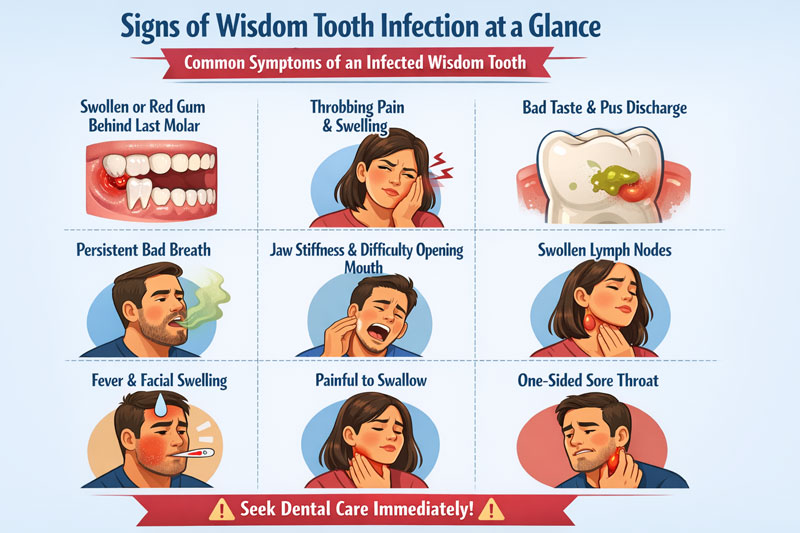
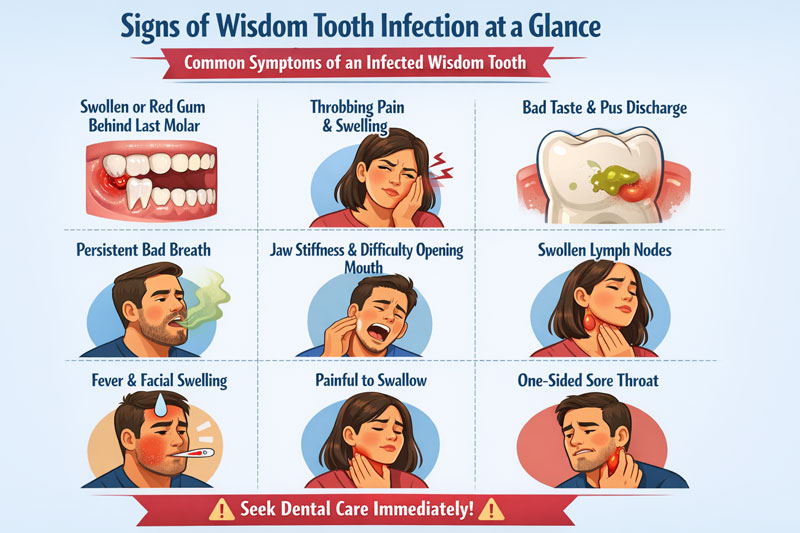
Signs of Wisdom Tooth Infection at a Glance
How to know if wisdom tooth is infected? If you only want a fast checklist, here are the most common signs of infected wisdom tooth:
- Swollen or red gum flap behind your last molar
- Worsening and throbbing pain around the wisdom tooth
- Bad taste in your mouth, pus, or any fluid draining from the area
- Bad breath that doesn’t improve with brushing or mouthwash
- Jaw stiffness or difficulty opening your mouth fully
- Tender, swollen lymph nodes under your jaw or in your neck
- Fever or visible facial swelling (urgent warning sign)
- Pain when swallowing, or a one‑sided sore throat on the same side as the wisdom tooth
If you notice several of these symptoms at the same time, especially fever, swelling, or trouble swallowing, the infection may be getting worse and should be assessed as soon as possible.
How to Know If Your Wisdom Tooth Is Infected
It’s normal to feel some pressure or mild pain when an infected wisdom tooth is erupting. The question many people have is: how to know if wisdom tooth is infected? A true infection usually has a few key features:
- Pain that gets worse instead of slowly improving
- Swelling in the gum or cheek around the tooth
- A bad taste or unpleasant smell that seems to come from that area
- Pain when chewing or biting down near the wisdom tooth
- Soreness that radiates into your jaw, ear, or throat on the same side
In simple eruption discomfort, tenderness comes and goes and often improves with gentle brushing and rinsing. In contrast, an infected wisdom tooth or infections after wisdom tooth removal often brings steady or throbbing pain, difficulty when you want to keep the area clean, and symptoms that build over a few days. Do not forget that sometimes the pain can be because of infection in wisdom tooth extraction.
Another warning sign of infected wisdom tooth is jaw stiffness. If you feel like it’s hard to fully open your mouth or yawning is painful, that can indicate deeper tissue irritation around the wisdom tooth.
The safest approach is to have the area examined by a dentist and, if needed, take an X-ray to see what is happening under the gum.
Infected Wisdom Tooth: What Causes It?
A wisdom tooth sits far back in your mouth, that is really difficult to brush and floss. When the tooth is partially erupted or impacted (stuck under the gum or angled), it creates tiny pockets where plaque and food easily collect. Over time, this infected wisdom tooth can lead to gum inflammation and eventually a wisdom tooth infection.
Common causes include:
- A partially erupted wisdom tooth with a loose gum flap over it
- Poor access for brushing and flossing around the back molars
- An impacted wisdom tooth that pushes against neighboring teeth or remains trapped in bone
- A cavity or decay in the wisdom tooth that reaches the nerve
- Biting or trauma to the gum flap, which makes it easier for bacteria to enter
Pericoronitis is one of the most frequent patterns: the gum around a partially erupted tooth becomes swollen, sore, and inflamed. If the area isn’t cleaned and treated early, bacteria can invade deeper tissues and create an infection that’s painful and harder to control at home.
Can a Wisdom Tooth Infection Cause a Sore Throat?
Do wisdom teeth cause sore throats? Many people are surprised to learn that a wisdom tooth infection can feel like a sore throat. The teeth, jaw, and throat share nerve pathways and are located very close to each other, especially near the lower wisdom teeth. As a result, inflammation around a wisdom tooth can cause pain to nearby areas.
Many patients notice:
- A sore throat on one side, matching the side of their painful wisdom tooth
- Pain when swallowing or turning their head
- Earache or a dull ache just in front of the ear
- A sense of pressure or fullness in the back of your jaw
But when a sore throat appears together with signs of wisdom tooth infection, such as swollen gum, bad taste, or difficulty opening your mouth, most of the time it is because of your wisdom tooth.
If you’re unsure whether your sore throat is dental or medical, it’s better to have both possibilities in mind. A dentist can check for an infected wisdom tooth, while a physician can assess other possible throat-related causes.
When a Wisdom Tooth Infection Becomes an Emergency
Most wisdom tooth infections start locally, but if bacteria spread beyond the area, they can cause more serious problems. Similar symptoms can also happen after wisdom tooth removal if the extraction site becomes infected.
. Contact us at Hemlock Dental Clinic immediately if you notice:
- Rapidly increasing swelling in your jaw, cheek, or neck
- Difficulty swallowing, speaking, or breathing
- High fever, chills, or feeling very unwell
- Pain that is intense, constant, and not relieved by over‑the‑counter medication
- Swelling that makes it hard to open your mouth or close your teeth together
Even if your pain is moderate, combining it with fever, facial swelling, or trouble swallowing is enough reason to seek same‑day care from an emergency dentist in Vancouver.
Wisdom Tooth Infection Treatment Options
The right treatment plan depends on how advanced the wisdom tooth infection is, where the tooth is located, and your overall health. The goals are to control infection, ease pain, and remove or reduce the source of the problem.
Common treatment options include:
- Professional cleaning and irrigation
The dentist cleans and flushes the area around the wisdom tooth to remove trapped food and bacteria under the gum flap. - Antibacterial or salt‑water rinses
You may be advised to rinse gently several times a day to keep the area clean while it heals. - Medications
Pain relievers can make you more comfortable, and antibiotics may be prescribed if there is a clear infection or risk of it spreading. - Smoothing or adjusting the gum flap
In some cases, the tissue around the tooth can be reshaped to make cleaning easier and reduce future irritation. - Extraction
If the tooth is impacted, badly decayed, or repeatedly infected, removing it is often the most predictable long‑term solution.
Your dentist will also assess the nearby teeth and your bite to make sure the infection hasn’t affected neighboring molars. In many cases, treating the infection quickly and planning a future extraction helps you avoid repeated painful episodes.
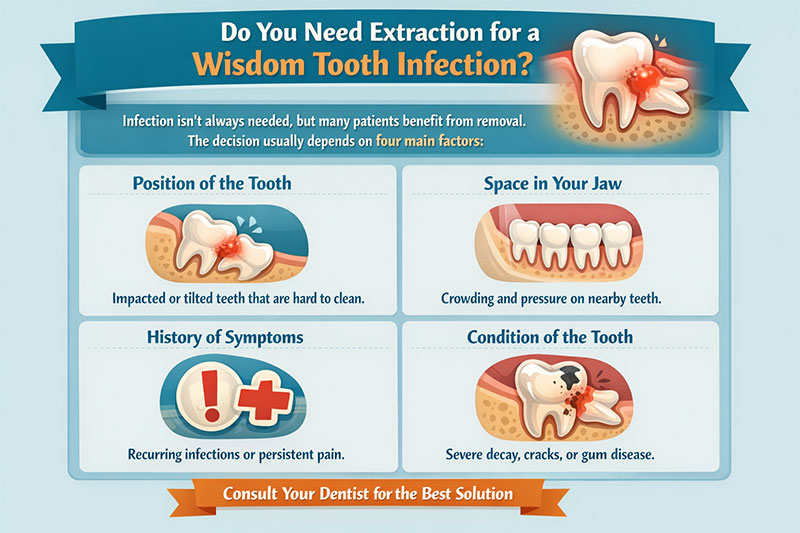
Do You Need Extraction for a Wisdom Tooth Infection?
Infection in wisdom tooth extraction is not always neede, but many patients benefit from removal. The decision usually depends on four main factors:
- Position of the tooth
Impacted or tilted wisdom teeth that are hard to reach and clean are much more likely to cause repeated infections. - Space in your jaw
If your jaw is too small to accommodate wisdom teeth, they can crowd or damage neighboring molars. - History of symptoms
One mild episode may be monitored. Recurring pericoronitis or multiple wisdom tooth infections often point toward extraction as a long‑term fix. - Condition of the tooth
A wisdom tooth with significant decay, cracks, or gum disease is less likely to be worth saving. And if the thought of an extraction makes you anxious, sleep dentistry in Vancouver can keep you completely comfortable through the whole procedure.
In younger adults, removal of high‑risk wisdom teeth is common, especially when impacted wisdom tooth symptoms are present on X‑rays even before severe pain starts. In older patients, your dentist will balance the benefits of extraction with healing time, medical history, and your comfort.
Infection After Wisdom Tooth Removal: Signs & Timeline
Even when everything is done correctly, there is still a small chance of infection in wisdom tooth extraction sites. Normal healing after wisdom tooth removal imclude:
- Mild to moderate pain for a few days
- Swelling that peaks around day 2 or 3 and then gradually improves
- Minor bruising near the jaw or cheek
- Slight oozing or blood in saliva on the first day
- Steady day‑by‑day improvement in comfort and function
Infection Signs
Signs of infection in wisdom tooth extraction after removal includes:
- Pain that improves at first, then worsens again after several days
- New or increasing swelling around the extraction area
- Pus or visible discharge from the socket
- Persistent bad taste or bad breath that doesn’t respond to gentle rinsing
- Fever, feeling unwell, or swollen lymph nodes
- Difficulty opening your mouth or chewing
Dry Socket
People often worry about dry socket as well. A dry socket occurs when the blood clot in the extraction site is lost too early. It usually causes intense, radiating pain and a visible “empty” socket, but it doesn’t always cause swelling or fever. An infection, on the other hand, is more likely to include swelling, discharge, and general signs of illness. If you suspect an infection or dry socket, contact us at Hemlock.
Normal vs Warning: When to Watch and When to Call
Here is a fast guide:
| Situation | Usually normal | Warning – contact a dentist |
| Pain | Mild to moderate, gradually improving | Severe or throbbing pain, or pain that returns and worsens after a few days |
| Swelling | Mild swelling that peaks around day 2–3 | Rapidly increasing swelling in face, jaw, or neck |
| Taste / breath | Slight bad taste that fades with rinsing | Strong bad taste, pus, or bad breath that doesn’t improve |
| Fever | No fever, or very low‑grade for less than 24 hours | Persistent fever, chills, or feeling very unwell |
| Function | Slowly easier to open and chew | Increasing difficulty opening mouth, swallowing, or breathing |
How to Prevent Wisdom Tooth Infections
You can’t control how your wisdom teeth grow, but you can reduce your risk of wisdom tooth infection with some consistent habits and proactive care.
Practical Prevention Tips
- Pay extra attention to the back of your mouth when brushing
- Use floss or interdental brushes to clean between molars
- Rinse with salt water or an antibacterial mouthwash if you have partially erupted wisdom teeth
- Schedule regular check‑ups so your dentist can monitor impacted wisdom tooth symptoms on X‑rays
- Consider early evaluation in your late teens or early twenties to discuss whether removal makes sense for you
- After an extraction, follow all post-operative instructions carefully, including avoiding smoking, rinsing gently, and sticking to soft foods at first, to lower the risk of infection and dry socket.
Wisdom Tooth Infection Care at Hemlock Clinic in Vancouver
Wisdom tooth infections can start with mild gum irritation but may quickly progress into painful swelling, difficulty opening the mouth, or even throat discomfort if bacteria spread around a partially erupted tooth. Recognizing early signs of wisdom tooth infection, such as persistent pain, bad taste, swollen gums, or jaw stiffness, can help prevent more serious complications like deeper tissue infection or problems after extraction. At Hemlock Dental Clinic in Vancouver, our team focuses on identifying the cause of the infection, relieving pain, and recommending the safest long‑term solution. Contact us now or fill out the form on this page to receive a fast booking.
FAQs
How do I know if my wisdom tooth is infected?
Common signs of an infected wisdom tooth include swollen or red gums around the tooth, throbbing pain, bad taste or pus, persistent bad breath, and difficulty opening your mouth. Some people also notice jaw pain, earache, or a sore throat on the same side as the tooth.
Can a wisdom tooth infection cause a sore throat?
Yes. Because the nerves and tissues around the jaw and throat are closely connected, inflammation from a wisdom tooth infection can sometimes cause pain when swallowing or a sore throat on one side of the mouth.
What causes a wisdom tooth infection?
Most infections occur when a partially erupted or impacted wisdom tooth traps food and bacteria under a gum flap. This condition, known as pericoronitis, can quickly lead to swelling, pain, and infection if the area is difficult to clean.
What are the signs of infection after wisdom tooth removal?
Signs of infection after wisdom tooth extraction include worsening pain a few days after surgery, swelling that increases instead of improving, pus or discharge from the extraction site, fever, and persistent bad taste or bad breath.
Does an infected wisdom tooth always need to be removed?
Not always. Mild infections may be treated with cleaning, rinses, or medication. However, if the tooth is impacted, repeatedly infected, or difficult to keep clean. Dentists often recommend wisdom tooth extraction to prevent future problems.