Impacted wisdom tooth symptoms often include pain at the back of the jaw, swollen gums, bad breath or a bad taste, and difficulty opening your mouth. Some people may also notice facial swelling, pressure, or pain that spreads toward the ear or throat.
These symptoms do not always mean the tooth needs to be removed, but ongoing pain, infection, or swelling should be checked by a dentist. If you need help call us at Hemlock Dental Clinic or fill out the form to set a checkup time with Dr. Alavi.
What Are Common Impacted Wisdom Tooth Symptoms
The most common signs of an impacted wisdom tooth include:
Sign 1: Pain at the Back of the Jaw
Pain or pressure behind your last molar is one of the most common symptoms.
Sign 2: Red or Swollen Gums
The gum around the wisdom tooth may become sore, red, or swollen.
Sign 3: Bad Breath or a Bad Taste
Food and bacteria can become trapped around a partly erupted wisdom tooth.
Sign 4: Difficulty Opening Your Mouth
Swelling and inflammation around the tooth may make it harder to open your mouth normally.
Sign 5: Pain When Chewing
You may feel pain or pressure when biting or chewing on the affected side.
Sign 6: Pain That Spreads to the Ear or Throat
Pain from an impacted or inflamed wisdom tooth can sometimes spread toward the jaw, ear, or throat.
Sign 7: Facial or Jaw Swelling
Visible swelling around the jaw or cheek can be a sign that the area needs dental attention.
What Is an Impacted Wisdom Tooth?
According to sources such as ADA, an impacted wisdom tooth is a third molar that does not have enough space to grow into its normal position. Instead of fully emerging through the gum, the tooth remains trapped under the gum tissue or partially stuck in the jawbone.
Impacted wisdom teeth can grow at different angles. For example, a horizontal impaction occurs when the tooth grows sideways and presses against the neighboring molar. Because these teeth are difficult to clean, food particles and bacteria can easily accumulate around them.
Some signs of impacted wisdom tooth are not noticeable symptoms at first. However, others can lead to problems such as pain, swelling, gum inflammation, infection, or the formation of cysts if they are not properly monitored and treated by general dentistry.
Mild / Early Symptoms (Annoying and not urgent)
At the initial phases, impacted wisdom tooth symptoms are:
- Aching or pain in the background of the final molar on one or both sides.
- Red, tender, or swollen gums in the wisdom tooth region.
- Having bad breath or bad taste due to trapped food and bacteria under the gum flap.
- Slight problems cleaning or flossing around the tooth due to it being partially covered by gum or tilted.
These symptoms tend to appear and disappear, but it is one of the signals that the tooth is hard to keep clean and might slip into an infected condition.
When Should an Impacted Wisdom Tooth Be Removed?
Wisdom tooth removal may be recommended if the tooth is causing repeated problems, such as:
- Ongoing or repeated pain
- Repeated infection
- Tooth decay that cannot be treated easily
- Gum disease around the tooth
- Damage to the tooth next to it
- A cyst or another problem seen on an X-ray
Not every impacted wisdom tooth needs to be removed. If it is healthy and not causing problems, your dentist may recommend monitoring it instead.
Worried About an Impacted Wisdom Tooth?
If you have ongoing pain, swelling, or signs of infection, book a wisdom tooth checkup at Hemlock Dental Clinic in Vancouver. We can examine the area, take an X-ray if needed, and explain whether the tooth should be monitored or removed.
Moderate Symptoms (Typically requires dental examination)
Moderate impacted wisdom tooth symptoms can sometimes become more noticeable as the problem progresses. Common signs can include:
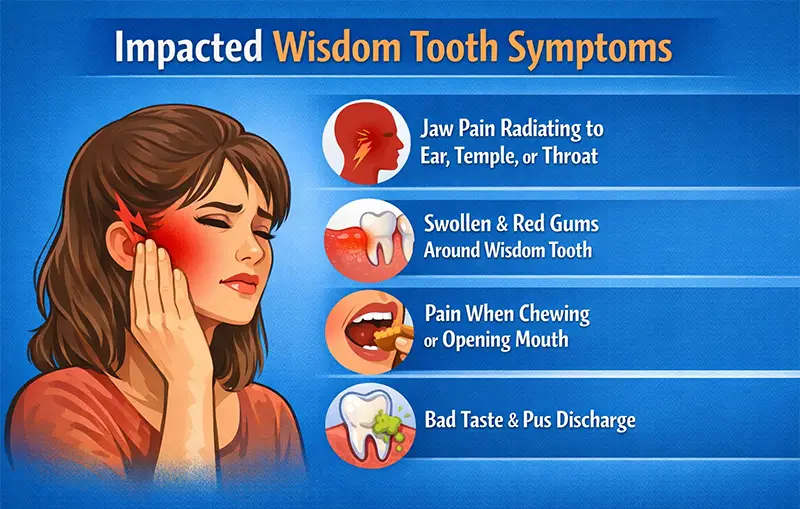
- Pain at the back of the jaw that may spread to the ear, temple, or throat.
- Swelling of the gums or cheek around the wisdom tooth.
- Discomfort when you are chewing, biting, or opening your mouth.
- A bad taste in the mouth or pus coming from the area around the tooth.
A good dental examination and X-ray are also necessary at this stage to check the location of the tooth and eliminate the possibility of deeper infection or damage to the adjacent molar.
When Are Wisdom Tooth Symptoms an Emergency?
Get urgent dental or medical help if you have:
- Rapid or severe facial swelling
- Fever or feeling very unwell
- Increasing difficulty opening your mouth
- Trouble swallowing
- Trouble breathing
These symptoms may mean an infection is spreading and should not be ignored.
These signs can indicate a spreading infection, which needs urgent medical attention. If you notice symptoms like these, it’s important to seek care right away from an emergency dentist Vancouver, oral surgeon, or a hospital
Impacted Wisdom Tooth Infection (Pericoronitis)
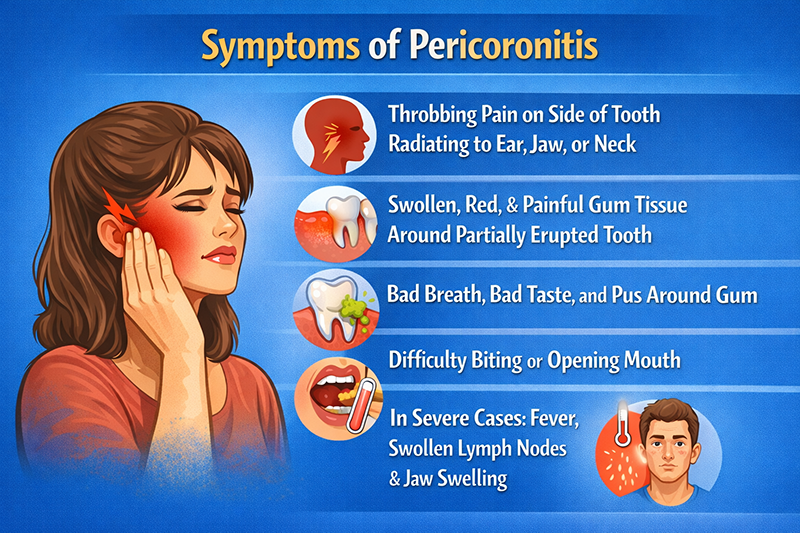
Pericoronitis is the inflammation or infection of the gum tissue that partially covers a wisdom tooth that hasn’t fully come in. When a tooth is partly erupted, food and bacteria can easily get trapped under the gum flap, which can lead to irritation.
Common symptoms include:
- A throbbing pain around the wisdom tooth that may spread to the ear, jaw, or neck.
- Red, swollen, and tender gum tissue around the partially erupted tooth.
- Bad breath or a bad taste in the mouth, and sometimes a small amount of pus.
- Difficulty when chewing food or opening the mouth fully.
- In more serious cases, fever, swollen lymph nodes, or noticeable swelling in the jaw or face.
If these symptoms appear, especially if swelling or fever is involved, a dental evaluation is important to prevent the infection from worsening.
Pericoronitis can evolve into a severe condition within a short period of time, so, an early assessment and intervention are essential to avoid the further distribution of the infection.
Horizontal Impacted Wisdom Tooth Symptoms
A horizontally impacted wisdom tooth is placed on its side in the jaw and usually bends directly on the molar next to it.
This position can cause:
- Pain that is deep, pressure-type behind the last molar, particularly during chewing.
- The teeth in the other back tooth are pushing against the affected tooth, causing it to crowd, shift, or become uncomfortable.
- There is a greater risk of decay or gum disease on the second molar as the space is virtually uncleanable.
Impacted Wisdom Tooth Cyst Symptoms
The impacted wisdom tooth cyst symptoms surround an impacted wisdom tooth. Although cysts are silent initially, they can cause:
- Constant pain in the jaw or face around the affected tooth.
- Swelling in the locality or fullness of the jaw or gum.
- The mouth may open less completely, or you may feel that you have a different bite.
- Tightening of adjacent teeth in case the cyst has destroyed the supporting bone.
Un-treated cysts may harm either the jawbone or nerve, so emergency surgical assessment and removal of the tooth (and even the cyst lining) is normally advised.
Do Wisdom Teeth Cause Sore Throats?
Yes, wisdom teeth that are impacted or infected may cause or lead to a sore throat on the same side as the impacted or infected tooth.
When bacteria accumulate around a partially erupted tooth, infection and inflammation may pass to adjacent tissues, resulting in:
- Pain in the throat that is exacerbated by swallowing or by moving the jaw.
- Red swollen lymph nodes in the jaw or neck, and even low-grade fever.
- Tooth, throat, ear,
- or side of the face pain.
Impacted wisdom teeth are not the only cause of sore throats, so a dental examination can help to determine the reason.
When Do You Need Wisdom Tooth Removal?
Wisdom tooth removal may be recommended if the tooth is causing repeated problems, such as:
- Ongoing or repeated pain
- Repeated infection
- Tooth decay that cannot be treated easily
- Gum disease around the tooth
- Damage to the tooth next to it
- A cyst or another problem seen on an X-ray
Not every impacted wisdom tooth needs to be removed. If it is healthy and not causing problems, your dentist may recommend monitoring it instead.
Wisdom Tooth Infection Treatment Options
Treatment depends on how severe the symptoms are and what is causing the infection. Common approaches include:
- Cleaning and flushing the area around the wisdom tooth to remove trapped food and bacteria.
- Antibacterial mouth rinses or prescription antibiotics if the infection is spreading.
- Pain relief medications and warm salt‑water rinses to soothe the gums.
- Wisdom tooth extraction if the main issue is tooth position, repeated infections, or cyst formation.
Your dentist will review your medical history and any medications you take to choose the safest treatment plan, especially if sedation or oral surgery is needed.
| Treatment Option | Purpose |
| Cleaning and irrigation | Remove trapped food and bacteria around the wisdom tooth |
| Antibacterial mouth rinse / antibiotics | Control and prevent the spread of infection |
| Pain medication and saltwater rinses | Reduce pain, swelling, and inflammation |
| Wisdom tooth extraction | Remove the source of repeated infection and prevent future complications |
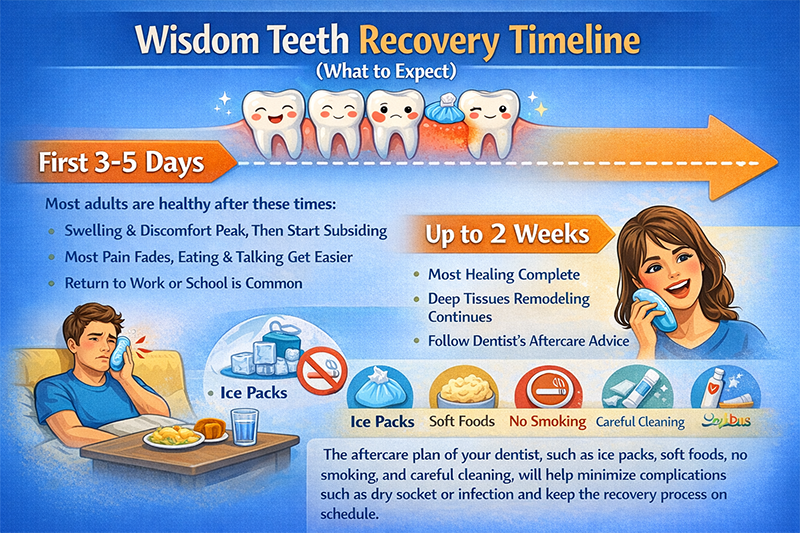
Wisdom Teeth Recovery Timeline (What to expect)
Healing times can be different, but for most healthy adults the general pattern looks like this:
First 3–5 days:
Swelling and discomfort are usually strongest during the first couple of days, then gradually start to improve. Many people can return to work or school within a few days after a simple extraction. Day‑to‑day pain becomes much more manageable, and eating and speaking feel more comfortable.
Up to 2 weeks:
The gums continue to close and heal. Most of the noticeable healing happens within the first two weeks, although the deeper tissues may continue to recover for several more weeks.
The aftercare plan of your dentist, such as ice packs, soft foods, no smoking, and careful cleaning, will help minimize
Wisdom Teeth Checkup at Hemlock Dental Clinic
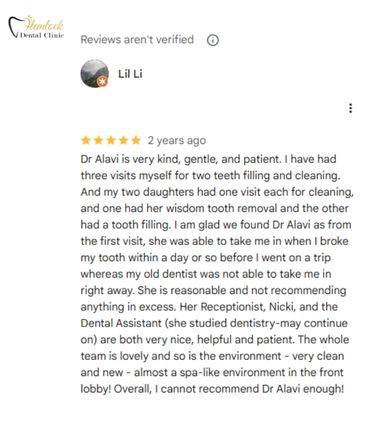
Our patient, Lil Li said:
Dr Alavi is very kind, gentle, and patient. I have had three visits myself for two teeth filling and cleaning. And my two daughters had one visit each for cleaning, and one had her wisdom tooth removal and the other had a tooth filling. I am glad we found Dr Alavi as from the first visit, she was able to take me in when I broke my tooth within a day or so before I went on a trip whereas my old dentist was not able to take me in right away. She is reasonable and not recommending anything in excess. Her Receptionist, Nicki, and the Dental Assistant (she studied dentistry and may continue on) are both very nice, helpful and patient. The whole team is lovely and so is the environment, which very clean and new, almost a spa-like environment in the front lobby! Overall, I cannot recommend Dr Alavi enough!”
Quick Checkup for Wisdom Teeth at Hemlock Dental Clinic
If you have trouble with a wisdom tooth, which is causing you persistent jaw pains, swelling, sore throat on one side, or any of the symptoms mentioned above, you do not necessarily have to wait until it gets nearly unbearable before you take some action.
Our dentists at Hemlock Dental Clinic in Vancouver administer low-dose digital X-rays and soft analysis that determine the condition of your wisdom teeth, give you a clear explanation of your choices, and develop a treatment program that fits your health and your schedule. Contact us now to set an appointment with Dr. Alavi at Hemlock Dental Clinic.
FAQs
How to Tell If Your Wisdom Teeth Are Coming In?
Wisdom teeth usually start coming in between the ages of 17 and 25. You may notice pressure or a dull ache at the back of your jaw, swollen gums behind your last molars, or difficulty opening your mouth fully. A dental X-ray can help your dentist check whether the teeth have enough room to come in.
What are the most common impacted wisdom tooth symptoms?
Common impacted wisdom tooth symptoms include pain at the back of the jaw, swollen or tender gums, bad breath or a bad taste, pain when chewing, and difficulty opening your mouth. Infection can also cause facial swelling or fever.
Can I know whether my impacted wisdom tooth symptoms are an emergency or not?
It is an emergency in case you are in a lot of pain, swelling is growing rapidly, you cannot swallow or breathe, you have a fever, or there is pus around the tooth. Consult us now.
Do wisdom teeth cause sore throats or earaches?
Yes. The aching of an inflamed or infected wisdom tooth may spread to your throat, ear, jaw, or head, so it can seem to be earache or sore throat that will not go away.
Should all the affected wisdom teeth be extracted?
No. Some of them are treatable by frequent check-ups and X-rays, but recurring pain, infection, damage, cysts, or bite issues most often indicate that it is safer to remove the tooth.
How long does it take to recover after having wisdom teeth removed?
The majority of individuals resume normal life after 2-3 days, and the swelling and soreness have subsided during the first week, and comfortable eating has taken place after 1-2 weeks.